
Work 4 Hours a Day, Transform Your Life
The Art of Depth

We can’t focus anymore.
If you’re busy the majority of your day checking your inbox, responding to messages, shuffling papers and emergency requests, searching the web, and fighting distractions, you’re on track to getting replaced by A.I.
We already have network routers and autoresponders.
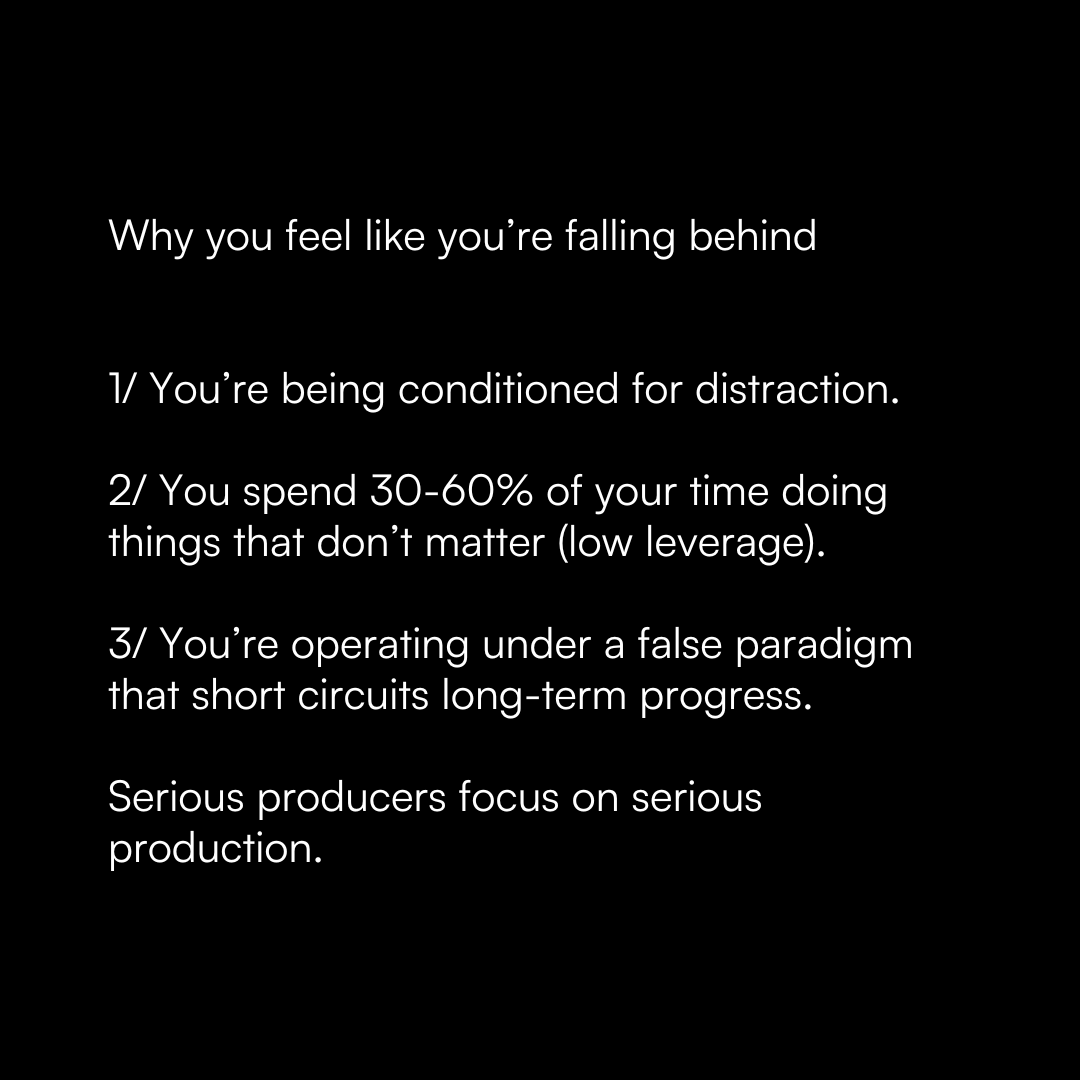
Most people can’t focus and spend the majority of their time on things that simply don’t matter.
They live out of their inboxes and messages pretty much the entire day. A 2012 McKinsey study surveyed over 2000 participants and showed that the average participant spends 60% of their workday doing electronic communication—searching for information, checking messages, and replying to emails. 30% of their total day went to email alone. Out of a 40 hour work week, that’s anywhere between 12 and 24 hours of productivity lost to random communications and searches. According a RescueTime study of over 50,000 participants, the average knowledge worker spends 40% of their productive time multitasking with email, getting just 1 hour and 12 minutes of uninterrupted time every day.
This all constitutes shallow work.
Shallow work: “Non-cognitively demanding, logistical-style tasks often performed while distracted that do not add much new value and are easily replicated.” — Cal Newport, Deep Work
Phase 3 is here.
From a neurological standpoint, this creates a properly shallow and unfulfilling life, as life is essentially sum of where you focus your attention.
But from a current reality perspective, we are operating in a globally competitive, phase 3 information economy consisting of rapidly changing, complex systems.
If you want to thrive in this disruptive landscape, you must:
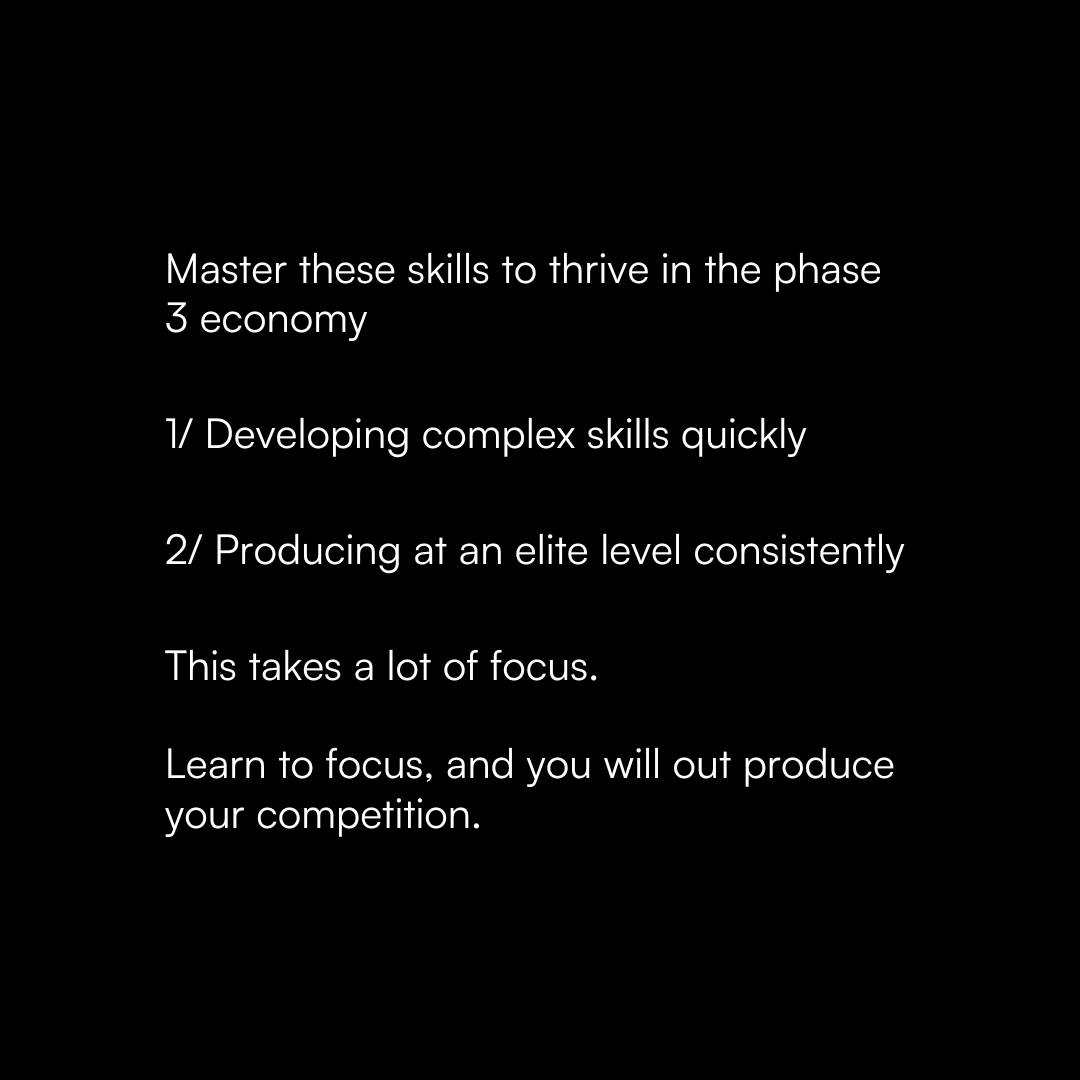
1/ Master the art of learning complex skills quickly (this demand will increase with the rise of A.I.—disrupting 40-60% of knowledge work), and
2/ Produce the absolute best you’re capable of, consistently (due to the infinite reach of the information economy, those who produce the most valuable things are greatly rewarded).
Your success in each of these meta skills directly depends on your ability to perform extended periods of highly concentrated work on challenging tasks, consistently and over the long term.
When Newport wrote his book in 2012, the Deep Work premise presented a unique opportunity for the rare few who would adopt it. All of that remains increasingly true—we’re still glued to our phones.
Only this time around, we’re cornered in phase 3. We’ve seen a record high of inflation, mortgage rates, and layoffs since 2008. 2023 was the “year of efficiency” as Mark Zuckerberg called it.
In a global economy that chews up and spits out those who can’t handle the workload, depth is currency.
In phase 3, it is necessity.
Architect your life around deep work, and you will thrive. Protect it with a violent (or ruthless) level of discipline. Otherwise, you risk letting your life be consumed by the noise—where distractions win and your dreams die.
The Depth Framework
To actually do that, you need a systematic approach grounded in the science of the problem. This is the deep work solution:
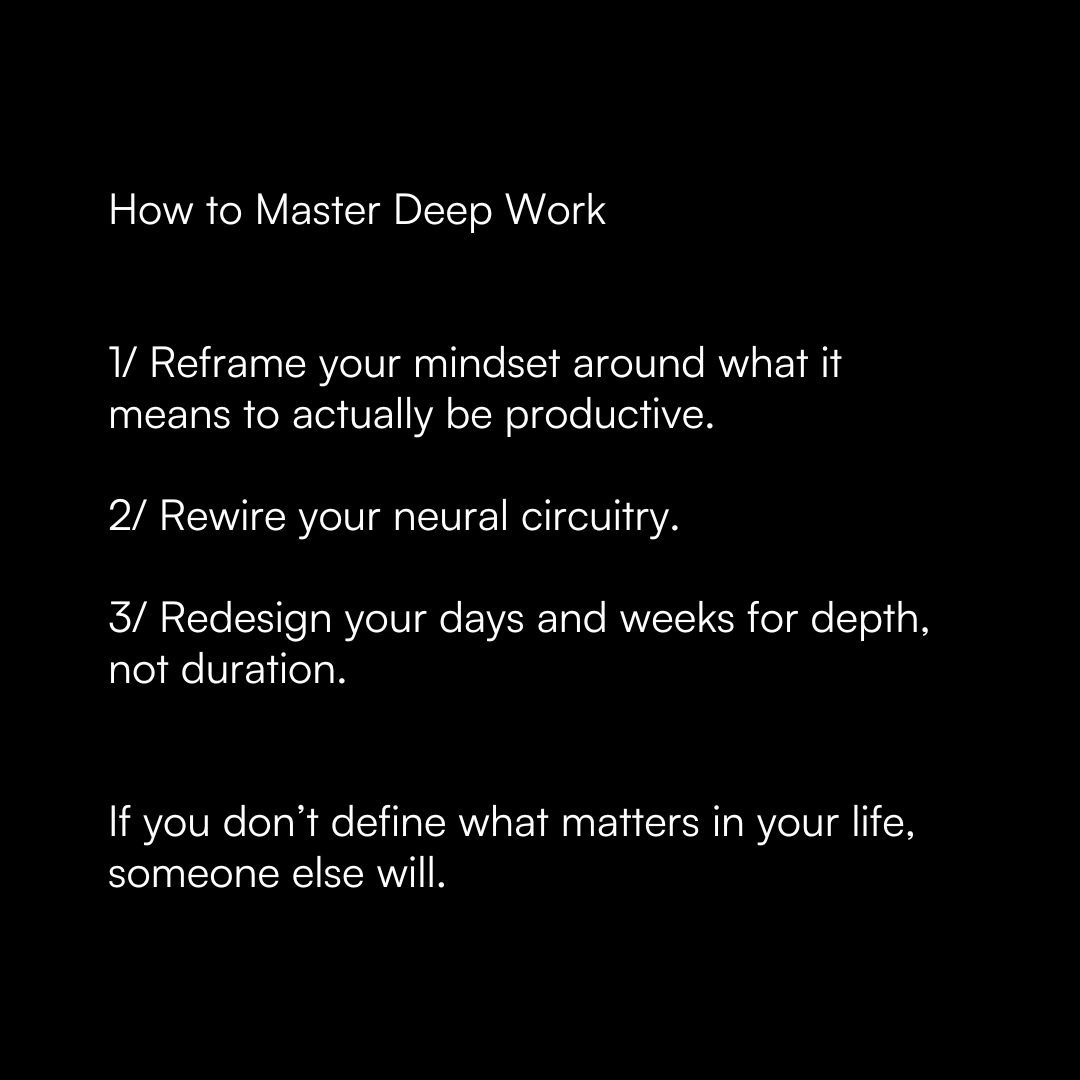
Reframe your mindset around what it means to be productive.
Rewire your brain’s neural circuitry for focus and learning.
Redesign your lifestyle for deep work.
The Depth Mindset
“Men of genius themselves were great only by bringing all their power to bear on the point on which they had decided to show their full measure.” — K. Anders Ericsson
The Definition of Deep Work
Deep work, originally coined by Cal Newport in his 2012 book of the same title, consists of “professional activities performed in a state of distraction-free concentration that push your cognitive capabilities to their limit. These efforts create new value, improve your skill, and are hard to replicate.”
Deep work is everything right now, and it always has been. Here’s why.
The Science of Deliberate Practice
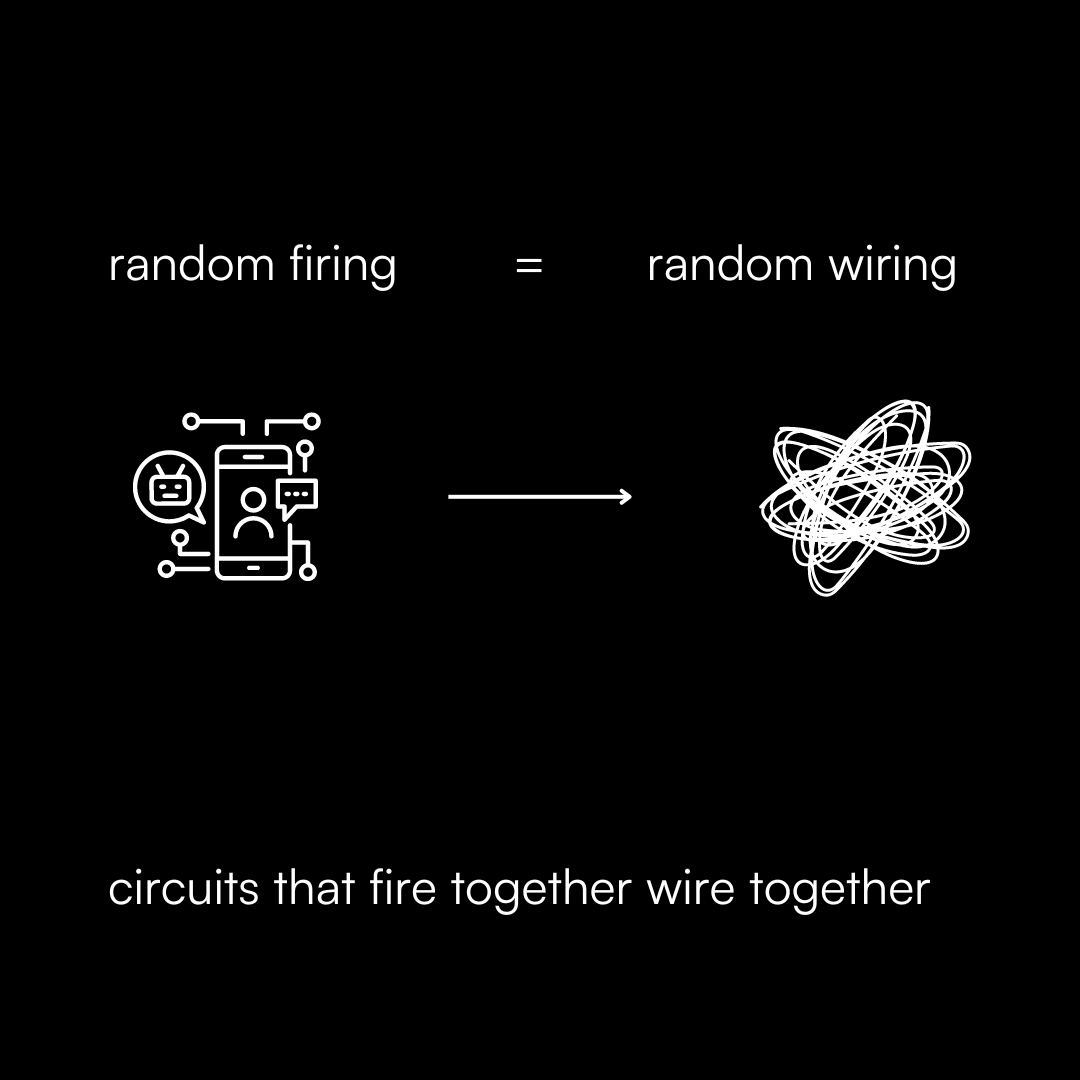
Skills boil down to brain circuitry, with neurons firing along pathways to complete tasks. Intense, isolated focus on a specific skill repeatedly activates the same circuit, triggering oligodendrocytes to wrap myelin around the neurons. This insulation allows faster, more efficient neuron firing, enabling rapid skill acquisition.
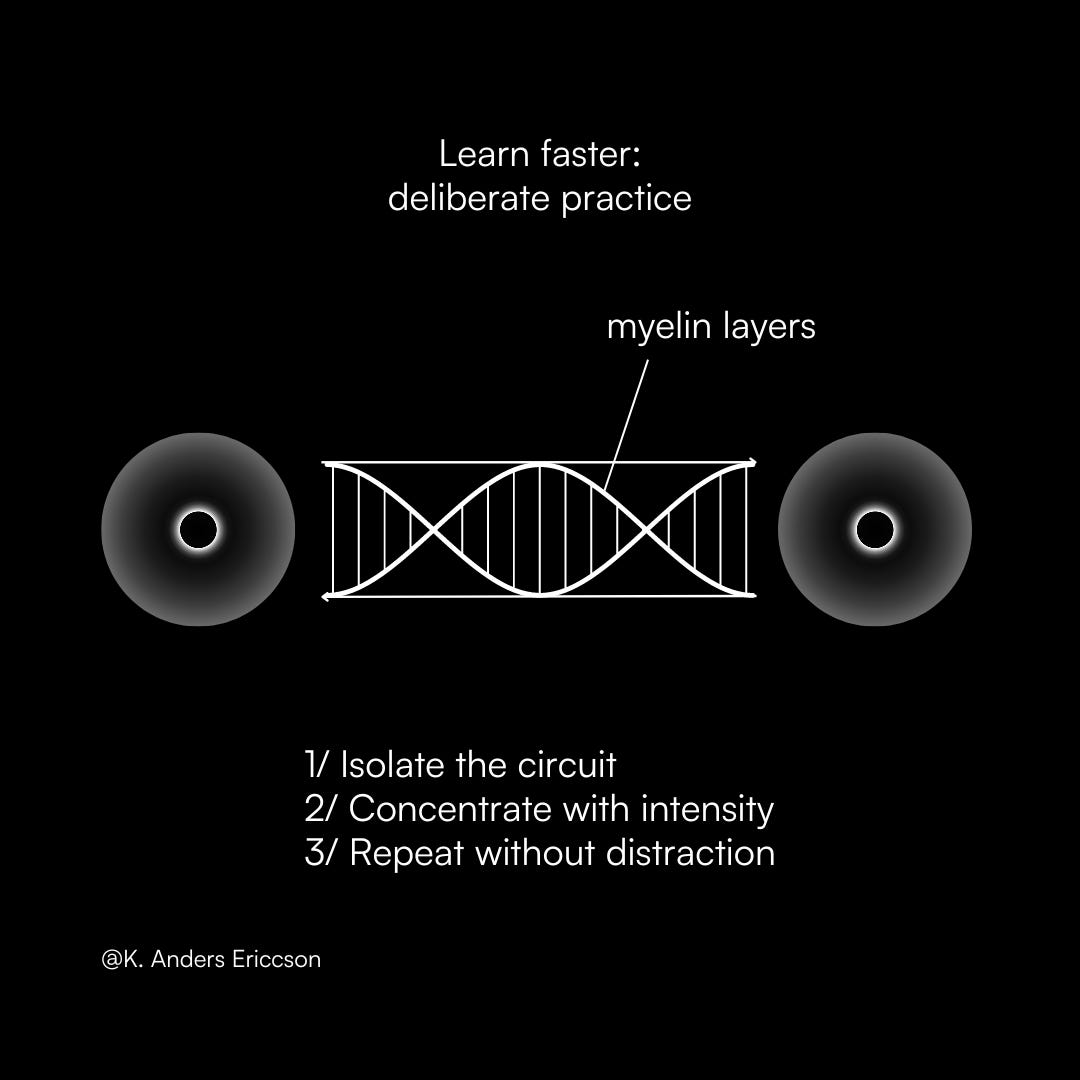
The only way to isolate and progress these neural circuits required for complex skills is to focus all of your attention on that skill. Concentrating with zero distraction.
If you’re operating in distraction, you cannot isolate the relevant neural circuitry to trigger enough myelination.
In other words, you’re wasting your time.
“Diffused attention is almost antithetical to the focused attention required by deliberate practice.” — K. Anders Ericsson
Say you’re working on a challenging new skill, and at the same time your Twitter feed is open, you’re firing **too many circuits simultaneously and haphazardly, resulting in no isolation and no real progress.
If you’re comfortable concentrating, you will thrive in this economy.
If you are scared of depth and distraction is in hand, nothing will come easy for you.
The Quality Output Equation
Productivity emerges from a simple formula.
High-Quality Work Produced = (Time Spent) x (Intensity of Focus)
Cal Newport discovered a noteworthy pattern among fifty top-performing undergraduates from highly competitive colleges: they often studied less than their peers with slightly lower GPAs. The key to their efficiency was their ability to focus intensely. This "output equation" emphasizes that high concentration dramatically reduces the time needed to complete challenging tasks.
Similarly, research by Sophie Leroy at the University of Minnesota highlights the drawbacks of task-switching due to "attention residue." When participants switched from one task to another, those who had been interrupted showed poorer performance on subsequent tasks compared to those who completed one task before starting another. “People experiencing attention residue after switching tasks are likely to demonstrate poor performance on that next task” she concluded.
These concepts help explain why unbroken intensity is key to quality performance. If your brain is constantly carrying over previous task conditions into your next tasks, and you’re constantly switching tasks or being interrupted with distraction, you’re positioned for failure.
To perform well, you must work deeply. Serious producers focus on serious production.
Reclaiming Your Mind
We can mentally accept an abstract like “distractions are bad and depth is good.” But as humans, it’s more complicated. We’re quite poor at visualizing the consequences these distractions create in our lives, and these exact impacts are also quite difficult to measure in knowledge work (though there is ample research to show that distractions hammer your cognitive capacity and increasingly burn your time).
It’s hard to kill distraction because it’s hard to see how it’s killing your future.
“Clarity about what matters provides clarity about what doesn’t.” — Richard Feynman
It’s hard to kill distractions and false obligations when you can’t clearly see why they’re ruining your life.
Neurologically speaking, your brain constructs your worldview based on what you place your attention on. Skillful management of attention defines virtually every aspect of experience.
Most people fall into an unconscious worldview and attitude based on their circumstances and the things that happened to them.
How they feel is just a reaction to what happens to them.
Focus controls how we feel and act on a day-to-day basis.
Your world is the outcome of what you pay attention to.
If your attention is lost in a the black hole of false emergencies and distractions, your world will feel like a constant cycle of randomness and reaction.
If your attention is entrained in deep, meaningful work, your world will feel rich.
The Noise
Shallow concerns are constantly nagging at your attention.
“Read this article”
“Did you see her post?”
“Check out this song”
“Can we schedule a time?”
“What do you think?”
Texts, emails, notifications, (I haven’t even opened YouTube or TikTok yet)—they’re all just convenient organizing systems for other people’s agendas.
The habit of checking these feeds ensures that everyone else’s problems, most of which you can’t even act on, stay at the forefront of your mind.
This drains your cognitive stores for deep work and constrains you to a trivial view of reality, governed by stress, irritation, and frustration.
An Infinite Black Hole
There’s a never ending amount of drama and negativity you can interact with.
There’s an infinite amount of content you need to consume right now.
There’s an infinite number of messages, emails, and requests you could respond to.
At some point you must make the conscious decision to reject this shallow life, as it is diametrically opposed to a life of clarity, focus, production, and mastery.
Depth and flow necessitate the elimination of everything that is not relevant to your vision.
You cannot access the full powers of your mind when you’re cognitively overloaded with a nonstop baggage of sensory stimuli
You cannot find deep engagement, satisfaction, mastery, or deep “flow” when your days are stuck in shallow endeavors (more on this in the future).
You cannot unlock the full meaning of human consciousness when your time and attention are consumed in randomness.
Choose Devotion Wisely
Everyone devotes themselves to something:
For some, it’s the safety and comfort of material possessions, experiences, feeling cared for, exerting control, etc.
For the few, it’s the deep pursuit of mastery and consciousness: transforming their vision into reality.
They hone their abilities with respect, care, and deliberate attention.
Your greatest risk in life is the choice of staying safe.
Your greatest pain in life is the choice of staying comfortable.
Don’t choose short-term comfort at the cost of your long term dreams.
The Portal
Happiness and success are byproducts of mastery.
You find success when you master high level skills.
You master hard skills when you cultivate excellence as a way of life.
You cultivate excellence when you pay attention to the details.
You pay attention to the details when you tune out the noise.
You tune out the noise by protecting depth in your life and honing your attention on the vital few.
Depth implies a breakup with the noise and the cognitive overload and disorder that it has conditioned.
Having escaped the black hole, your time and attention is free to build a universe of tangible progress, sacred milestones, and shining achievements.
Deep work is your portal.
Get to the portal and you will win.
How to Enter the Portal: The Practices
The Output:Willpower Ratio: Stack The Deck For Focus
Everything from your schedule, to your habits, to your environment, should reflect a hierarchy that allows you to extract as much value as possible from the full powers of the human brain. The Eudaimonia Machine, conceptualized by David Dewane, gives a beautiful picture of what this might look like.
Eudaimonia is an ancient Greek concept for achieving one’s full potential. The blueprints David drew resembled a building, but his machine actually serves as a useful reference for architecting your entire lifestyle, from your schedule, to your habits, to your tools and environments.
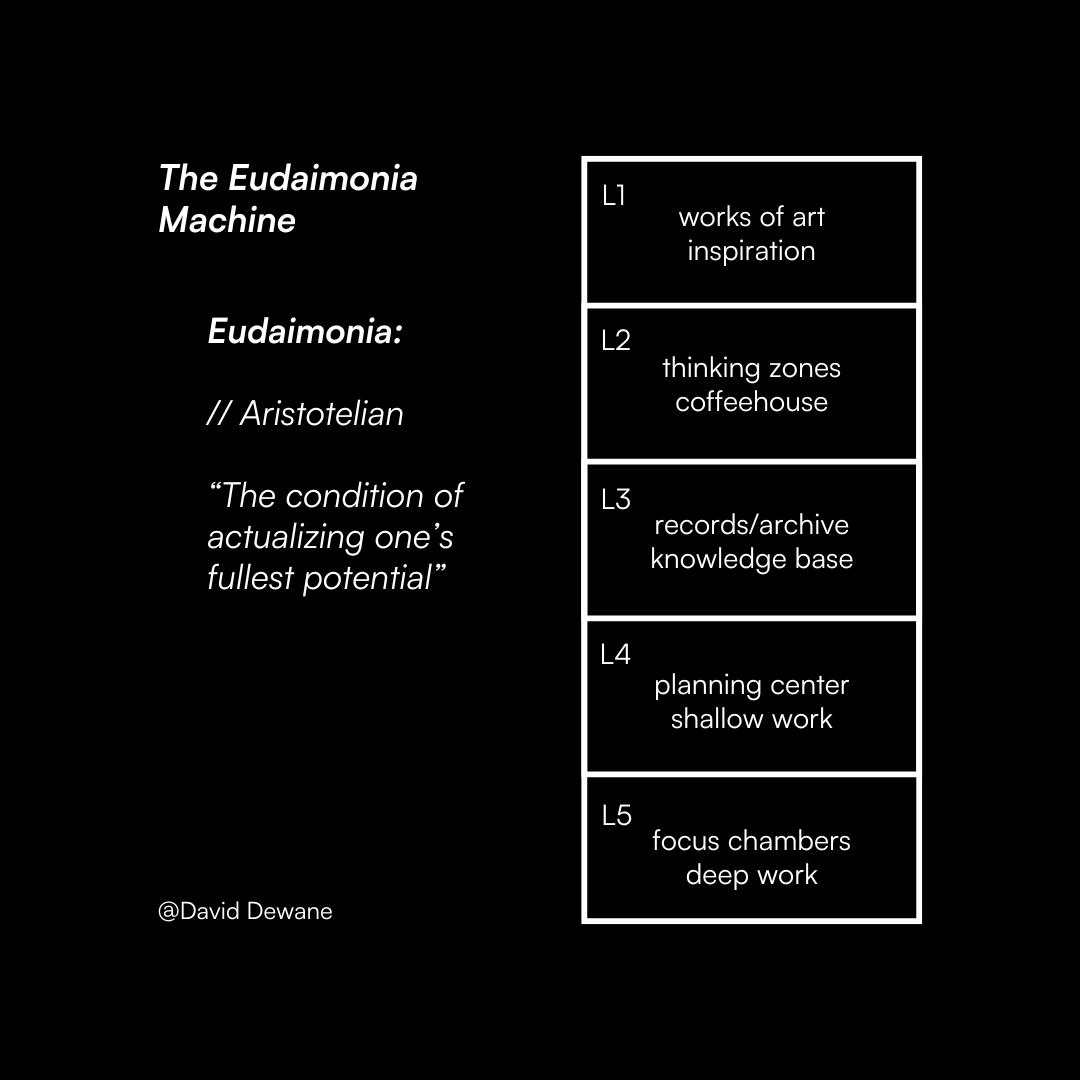
This is built on scientific principles: open spaces for recovery, subconscious processing, and inspiration (tall ceilings and open spaces help dilate the visual field and recover cognitive stamina), dedicated spaces for thinking on specific problems, managing data and knowledge, planning and strategizing work, and finally closed off “chambers” for concentrating deeply without interruption.
This will make more sense when you understand willpower.
We have a finite amount of willpower each day, and according to research by Wilhelm Hoffmann and Roy Baumeister, we’re fighting desires all day long. You’re constantly saying ‘no’ to all the random impulses that aren’t your priority—food, social media, surfing the internet, streaming tv, sex, etc.—to say ‘yes’ to the things are your priority.
Willpower (including focus) is a muscle that requires deliberate training and recovery. You have a finite store of willpower every day. You’re resisting the desire for distraction all day long until you have none left, and at that point you give into it.
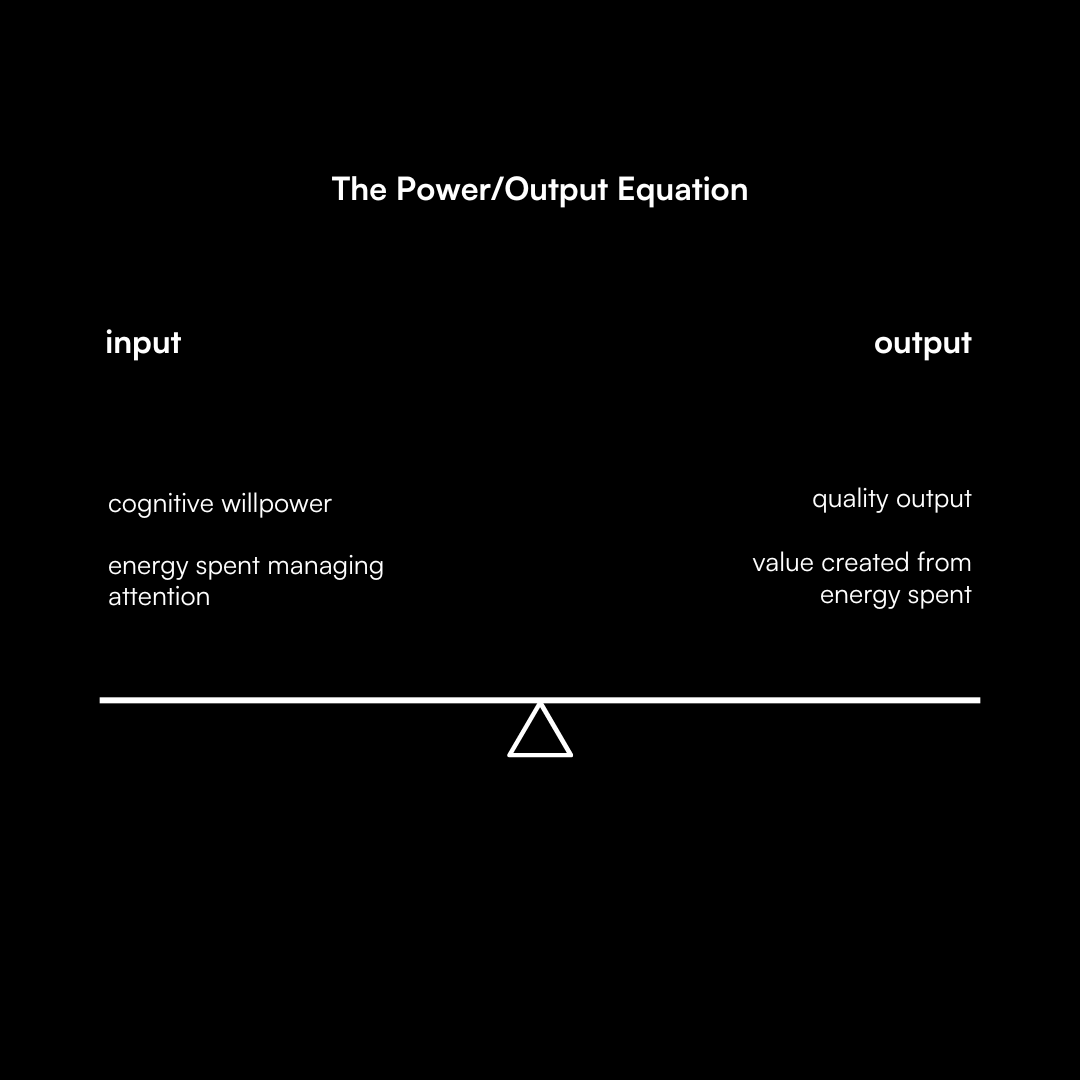
The secret to deep work is optimizing your power/output equation by building routines and systems that minimize friction (and thus the willpower required to get into deep work) and maximize our ability for concentration. The rest of this article is aimed at optimizing that ratio.
We need tools designed to:
1/ Reduce the energy it takes to achieve deep focus and sustain high-performance work.
2/ Increase the intensity and value of our concentration during these deep work sessions.
3/ Strengthen our ability to concentrate through ongoing training and proper recovery strategies.
Most people will waste significant portions of their time and energy fighting battles they could’ve won in advance with clear commitment, preparation, and proper systemization.
If you want focus, make it impossible not to focus.
If you want energy, stack the deck for great recovery.
Waste less energy saying no to distraction by taking it out of the equation.
Increase your energy for concentration by building your physical and mental stamina, and optimizing your environment and routines.
More on all that later.
Stack the deck in your favor, and watch your performance go through the roof.
1/ The Focus Chamber
Build your focus chamber as if it’s sacred—because it is.
This space is where you’ll forge your future. Think of it as your personal fortress equipped only with the essentials for producing your best work.
Whether it’s a secret tower away from your phone and communication tools, a table in the woods, a dark closet, or even the back of your car, build your focus chamber. Your work depends on it.
You need specifically curated spaces dedicated to serious work.
Where are you most productive?
Where can you escape to focus for long periods of time?
Each session here signals to your brain “it’s time to go deep.” This repeated exposure trains your brains neuroplasticity, where 'neurons that fire together, wire together.' Studies like the one on stimulus-dependent synaptic plasticity in the mouse primary visual cortex show how perceptual learning through synaptic mechanisms can effectively respond to sensory stimuli.
You can rewire your neural pathways based on sensory stimuli.
You can transform your work habits with consistent cues and mechanisms.
These cues reorganize the brain's pathways, boosting your ability to concentrate, and get to the deep work portal. Research on the influence of cortical activity on perception, which varies by behavioral state and sensory context, shows that your environment can optimize neural responses for better concentration and cognitive function.
That's why choosing and tailoring a distraction-free space for focus is vital.
A well-designed environment primes your brain for peak productivity and performance.
Make it personal. Every element serves a purpose in cuing your brain towards focus. Every time you see this space, you concentrate. Repeat that over time, and your brain begins to alter based on these new triggers and pathways.
You brain responds to positive cues (like focused environments) and negative cues (like distractions), whether you realize it or not.
Change the cues, and you change your circuitry.
Next, you need to build your ritual.
2/ The Ritual
The greatest creative minds think like artists but work like accountants.
There are various schools of thought on how to schedule deep work—the monks, the bimodals, the rhythmics, and the journalists. We’ll dive into them in a future release.
The most important factor is that you clearly define your process and that it lands in your calendar, consistently. This is where systems can change the game.
Developing your own macro and micro rituals to minimize friction and put your brain into flow is all that matters.
Choose a structure centered on ambitious visions, specific goals, and strategic plays.
1/ Where will you work and for how long? This is where your focus chamber comes into play.
Find the times where you can get the longest uninterrupted bouts of time. Invest in your location, it’s the foundation.
2/ How will you work once you start? You might place a ban on internet. You might lock your phone in the car. Maybe you just leave all devices at home and hide in your own version of a cabin in the woods.
3/ Develop a metric per session. This can be a word count, a number of outputs, etc. The objective is to remove all decision making from the process so you can just focus, (instead of constantly mentally calculating whether or not you’re working hard enough, what you should or shouldn’t be doing, etc.).
4/ Load your tools. What kind of materials, supplements, supplies, cues, and protocols will you need to perform at your best? Personally, it’s a cold shower, iced black coffee with MCT, meditation, walking, and lemon water, with a packet of LMNT salt. Make it yours.
5/ Schedule it. If it doesn’t land in your calendar, it dies in the ether of the other nice ideas you consumed online but never acted on.
The game is systemizing all of this so you’re not wasting your limited cognitive resources on moment-to-moment decisions.
Remember, deep work is sacred. It is the high impact work that moves every great thing forward.
Be intentional about it, and it will change your life.
Protect it with ferocity, so you can focus on creating things that matter.
Remember, once you schedule this, do not compromise on it. These blocks do not move. Treat them like a date with a significant other, because it’s a date with depth. You’re building the future. You either show up or you let it slip.
3/ Develop Concentration with Focus Protocols
There are a ton of ways to sharpen your focus.
Here are the easiest 5 ways to enhance your focus.
1/ Protect your sleep/wake cycle. This is the foundation of your baseline cognitive and physical energy every day.
Go to bed at the same time 6/7 nights of the week.
Get direct sunlight within the first 60 minutes of waking.
Get adequate amounts of dark exposure in the evening—dim the lights, turn off devices, go for an evening walk—this cues your brain it’s time for recovery.
Stop using your phone before bed. Use an analog alarm system. Place your phone outside your room. Hitting your brain with bright lights and notifications depletes your dopamine and focus the next morning.
Run a shut down ritual (more on this later) with a chosen work cutoff time.
Build a simple evening wind down routine for the last 2 hours-30 minutes of your day. Stretch. Walk. Meditate. Read. Journal. Do something you enjoy. Your brain needs time to be intentionally idle in order to recover and adapt to your day’s work.
2/ Train 2-3x per week.
If you yet haven’t made the decision to get into the best health of your life, make that decision this year.
Find a time when you can consistently hit your workouts, and stick to it.
Calisthenics, free weights, and mobility are great places to start.
Pair this with daily walks and you will feel extraordinary.
This is already a proven idea, so we’re not going to spend a ton of time convincing you to take care of your body.
If you’re not doing this, you’re just choosing a shortened lifespan and less energy to live it with.
3/ Mobilize your workflow.
Build in movement into your daily routine with walks and short bursts of bodyweight movements. It can be as simple as hitting a mobility flow in between meetings and taking 10 deep breaths before heading into your next work block.
You need moments to release tension and recalibrate your mind for what matters next. Get up every 50-90 minutes and meditate, walk, stretch, or use a tapping routine to re-stimulate blood flow and get back into full focus.
4/ Install a hard reset.
Whether it’s a long walk, a meditation, yoga, or an NSDR protocol, schedule a 10-30 minute block in the middle of your day to deeply recharge.
Studies show that NSDR (Non-Sleep Deep Rest) (traditionally yoga nidra) in particular increases dopamine levels up to 60% after the practice.
This 10 minute NSDR protocol is a great place to start with installing a hard reset.
5/ Practice productive meditation.
Cal Newport initially popularized this idea in 2012.
This trains both sides of the focus muscle, learning to resist distraction and continually focusing your attention back on the problem.
2-3 times per week, take a problem with you on a walking route or a thinking zone for 20 minutes.
State the known variables or components of your problem.
Ask the next step question. Play with the variables. Get your brain thinking about how you can move towards the next solution and preempting what might go wrong.
Consolidate your mental gains. Write them down as needed.
Repeat this circuit as many times as necessary.
4/ Run a Shut Down Program
You have to close the open loops in your brain and give it permission to disconnect.
For everyone resisting the work cutoff time, here are your three reasons for shutting down:
1/ It unlocks your subconscious mind, allowing it to process its vast database of knowledge and make connections you can’t make deliberately.
A 2006 paper in the journal Science by AP Dijksterhuis on Unconscious Thought Theory (UTT)
At a high level, this theory statees that high level decisions requiring the applciation of strict rules is for the conscious mind - calculations, strict proofs, etc.
however, decisions involving large amoutns of information and muliple value and potentially conflicting constraints - the unconscious mind is better suited
the theory hypothesizes that this is due to the fact that these parts foyour brain have more neuronal bandwidth avialble so they can move informtion faster and sift
your conscious mind is a computer that runs specific programs and it has a limited amount RAM - you only have so much working memory and attention to apply to solve problems -
but your unconscious (or subconscious) mind is like a database with algorithms working through terabytes of information in a matter of seconds.
the subconscious mind processes 11 million pieces of information at a time, while the conscious is only able to process 40-50
A shut down ritual ensures you diversify your workload. Your subconscious will lift more of the load, if you let it.
2/ Directed attention requires recovery.
The amount of cognitive energy and willpower you have every day is finite.
In a 2008 study, researchers divided participants into two groups: one walked through an arboretum and the other navigated a cityscape. Afterward, both groups undertook a challenging concentration task.
The nature group outperformed their urban counterparts by 20%.
Your brain needs time to restore its attention stores. Attention Restoration Theory (ART), first proposed in the 80s, proposed the concept of directed attention as a finite resource in your brain.
Once you’ve exhausted this directed attention, you will struggle to progress on complex tasks.
In general, activities that require more of your directed attention—the narrowing of the visual field—will deplete these stores. Think of navigating traffic or walking across streets.
Nature gives a beautiful antidote to this depletion in attentional stores. The expansive landscape naturally dilates and widens your gaze.
It doesn’t require the same directed attention, but it still provides gently fascinating stimuli that minimally occupy your mind, so you don’t feel the need to direct your attention at any one thing.
3/ The work replacing your evening down time usually isn’t that valuable.
If you’ve already done your deep reps and you’ve maximized that limit, your evening work will be operated with low cognitive energy, lower value, and a slower pace.
You could be using this time for free thinking, processing, and preparing for the next day.
Once you’ve drained your concentration bank, there’s not much value in wasting time on tasks that you can’t complete with the full powers of your mind. You naturally take longer and produce less because you’re already on empty.
Here are the rules for your shut down program.
Choose a work cutoff time and force yourself to stick to it. Constraints create innovation.
Review your inbox, daily tasks, calendar, messages, etc.
Make sure there’s nothing you missed. Check your deadlines.
Make sure you’ve emptied your brain of any tasks or ideas and uploaded those into a database or list that you’ll come back to later.
Schedule incomplete tasks and get a feel for the next day’s plan.
Then use a behavioral cue to condition your brain: i.e. “shutdown complete” (@Cal Newport).
This is cognitive behavioral therapy. You will ruminate about work post shut down.
And when you start stacking thoughts in circles, you will remind yourself that you completed the shut down ritual, so you are ok to disengage and breathe.
Mental health gives you the edge when playing the long game.
Stop bringing work to the bed or dinner table.
Stressing about things you’re not actively taking action on just creates negative associations in your mind with places that should be sanctuaries for relaxation and rejuvenation.
These settings are intended for you to be fully present and engaged with loved ones and things that matter to you.
5/ Create White Space
If you want to learn focus, you have to learn lack of distraction.
It’s white space.
Just like you wouldn’t want to read a sentence or book with all the words mashed together in one endless pileup, your brain doesn’t want to absorb life as one nonstop slur of consumption.
This doesn’t mean you have to throw your phone in a pond.
But you do have to break the pavlovian connection to your phone.
When you impulsively pick up your phone every time you’re bored, your brain will associate the condition of boredom with the automatic response of distraction.
Our brains respond quickly to conditioning.
But when create times to not have the distraction in hand, you condition your brain with the reality of not always having a distraction.
You need to build your tolerance for lack of novelty.
So when you’re sitting down to work on that really important project, you’re not impulsively darting away from focus every 5-10 minutes to check or answer something.
Your brain will learn to be ok without distraction.
And you will learn to concentrate faster and longer because of it.
White Space Accelerates Learning
There’s a beautiful superpower in white space.
A study had participants engage in bouts of intense learning followed by long periods of sensory deprivation. They weren’t necessarily in a black room with zero sense of time, but they weren’t hitting their brain with tons of novel stimuli.
What they found is something called “the gap effect” in neural processing. It occurs in REM sleep, some deep sleep, and during breaks after music or math studies.
During these breaks, the hippocampus plays the new information backwards and 30 times faster, resulting in massive learning acceleration.
They found similar results with the participants. After long periods of sensory deprivation, the participants would experience a hyperplastic response to the next activity they engaged in.
White space follows the same principle.
It gives your brain opportunities to do the unconscious processing it needs to learn and perform at its best.
Find pockets in your day for white space. Instead of filling them with noise, ritualize them.
Create times for stimulation, and times for white space (no stimulation).
White spaces are minimal cognitive lifts: walking in the woods, staring at the clouds, a quiet drive, opportunities where you can just think.
Constantly having distraction in the foreground blocks your unconscious learning and recovery in the background.
Start simple by keeping away from your phone for the first 20 minutes of your day, then slowly increase it.
It will be uncomfortable at first, but your brain will thank you with the cognitive rest and performance increases you’ll be experiencing.
6/ Weaponize Your Time
In order to protect your deep work, it ultimately has to show up in your calendar.
Time is what makes or breaks the millionaires.
They simply control time with coordinated strikes.
Here are the three tiers you need in your planning system:
1/ Seasonal Focuses: Every quarter, set clear objectives that align with your annual goals.
Focus Areas: Determine your main areas of focus for the quarter—what will drive most of your attention and resources? What matters most in the next 12 weeks?
Milestones: Establish key milestones to help gauge your progress throughout the quarter.
Review and Adjust: At the end of each quarter, review your achievements and setbacks and adjust your objectives and strategies accordingly.
2/ Weekly Planning: At the beginning of the week, assess your calendar for the upcoming days.
Prioritize Tasks: Identify critical tasks that need attention and which can be postponed or canceled to streamline your week.
Set Weekly Goals: Determine what you need to achieve by the end of the week to stay on track with your broader objectives.
Deadline Alignment: Check upcoming deadlines and plan your week to ensure you meet them without undue stress.
Delete Shallow Work: Remove as much shallow work as you possibly can, especially when it’s getting in the way of your #1 thing—your deep work. Shift blocks around so that you’re protecting your deep time.
Schedule Workouts & Resets: Decide when you’re going to train and when you’re going to reset. These are core energy routines that are vital to sustaining your performance and longevity.
Respect the Cutoff/Shut Down: There’s no point in setting a cutoff if your calendar doesn’t actually respect it.
Schedule White Space: Find the blocks of time where you’ll intentionally disconnect. It might just be a long walk on Sundays, or a Saturday half-day retreat where you escape somewhere beautiful and just think.
3/ Daily Time Blocking: Allocate specific blocks of time from the start of your morning to your daily cutoff. Giving each part of your day a job reduces your cognitive load, because you’re not juggling between 3 different priorities and whether or not you should be communicating. You’re simply following the blocks.
Visual Distinction: Make deep work special. Differentiate it. Put it on your wall. Mark X’s on the calendar every time you get your deep work reps. It’s the cornerstone of your day’s productivity, so make it meaningful. These associations only wire your brain for more focus.
Dedicated Communication Blocks: Designate specific times for emails and calls to minimize distractions during focus periods. Without this structure, you'll constantly battle the urge to check in, which disrupts your focus throughout the day.
Mono-Focus: Every block gets one assignment. This is what allows your brain to tune out the noise and lock in on the one thing that matters most.
Most people are grappling with all these scales at once, in their heads, ad hoc.
And it’s wreaking havoc on their cognitive capabilities and their long term progress.
When you work the tiers top down, you know you’re aimed in the right direction.
And you know your time is locked into that vision.
That is the definition of “coordinated strikes.”
Master your time and attention.
People will respect you for it.
They’ll stop constantly questioning whether or not you’re going to show up, because you’ve proven to them you’re a producer. You follow through. You create results.
Now you have more time for pushing, and more time for living your own life.
When you own your time and leverage it, you perform. Plain and simple.
The rulers of phase 3 are the commanders of their time and attention.
Your brain is a multi-million dollar piece of machinery, but most of us don’t know how to properly use and maintain it.
We’re taking the world by depth.
Join the movement, watch your performance 🚀.
— J