
Atomic Clarity - An Instrument for Clear Thinking in the Era of Infinite Optionality
Why you keep getting lost

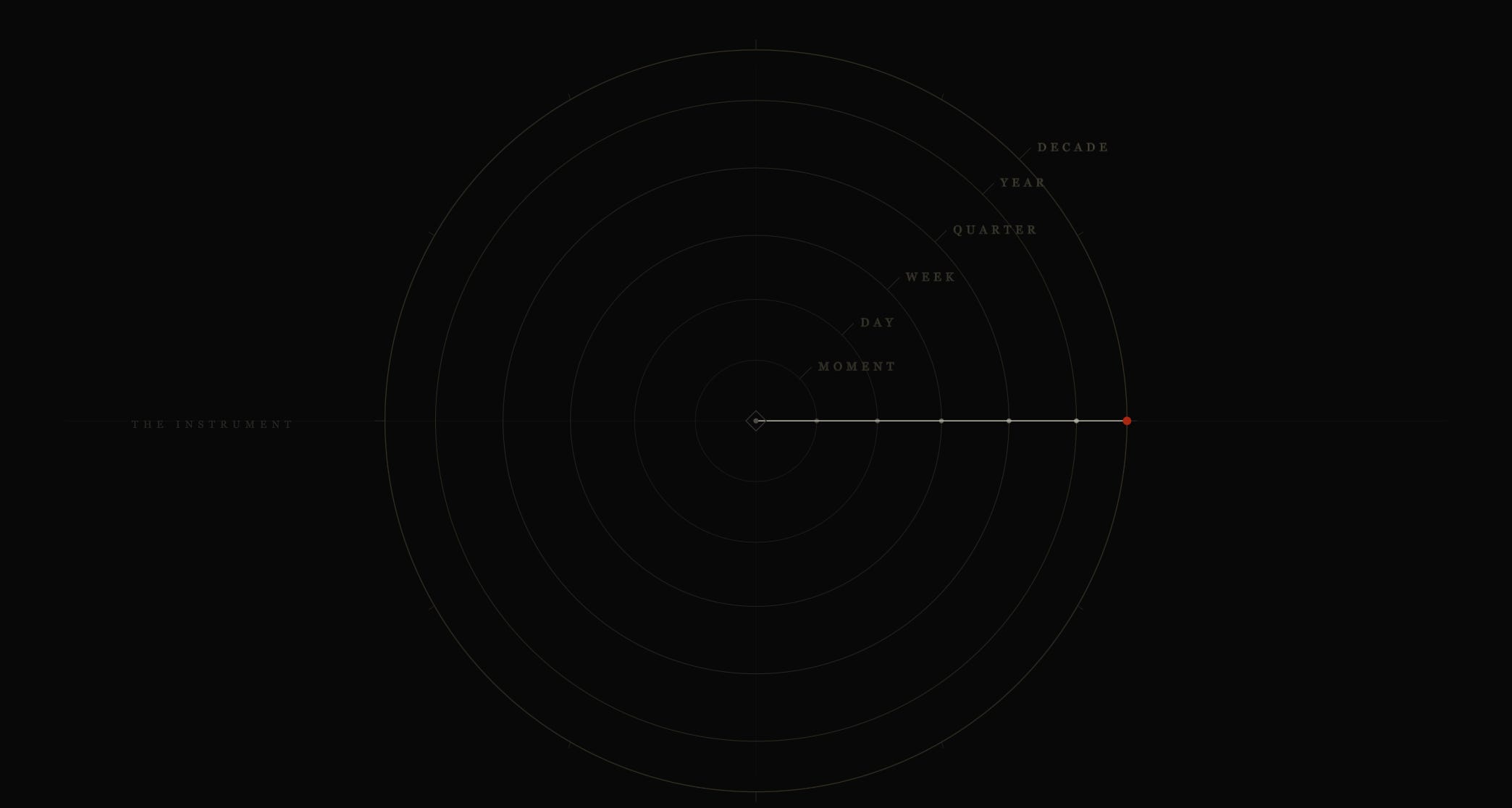
The instrument between your two ears dictates everything you experience.
Your mind isn’t something that happens to you.
It’s something you play.
It externalizes itself onto every meter of your experience.
How you train it to think, feel, and focus determines its range, depth, and capacity for clarity.
Most people have never touched its controls.
Someone else is holding them.
The algorithm. The substance. The group chat. The spiral at 2am. The cultural ideology about what success is supposed to look like at your age.
If you’re not holding them, someone else is:
You wake up hoping something good happens.
By noon you’re wandering.
By 3pm you’ve half finished three things and committed to none of them.
By 10pm you can’t remember or explain anything that happened that day.
Most of your decisions are an unconscious byproduct of your state and your assumptions.
Which is why you won’t reach your goals this year.
Your brain is a biological instrument. Its capacity for clarity, for strategic thinking, for creativity - is variant.
It depends on basic factors like sleep, nutrition, movement, what you’ve been feeding it for the last 72 hours.
And on a higher level, it depends on whether you’ve even learned to think deliberately - at the right altitude, with proper calibration, at the right time - or whether you’ve just been reacting to your past.
Most people are reacting to history.
Running an F1 car on garbage fuel, no maintenance, and a dead battery - wondering why life sucks.
I wrote this essay to solve that - because I’ve experienced it too many times to keep on repeating it:
This is a detailed guide on how to think clearly at every scale - from the next ten minutes to the next ten years. A state diagnostic. A six-horizon framework. And of course the AI prompt that runs the whole thing if you like interactive learning & application.
Save this somewhere you’ll remember it. You’ll want to use this compass repeatedly.
This is Atomic Clarity.
Here’s how it works.
Clarity is the atomic element of performance.
It is the mechanism behind the world’s most successful leaders, thinkers, & founders.
They were so clear that their daily living compounded into something that outlived themselves. it’s the ultimate example of compound interest.
They invested with so much focus that their returns lasted generations beyond them.
I believe you can create similar results in your own life as well - but it doesn’t require you working 16 hours a week, selling your soul to a corporation, being an influencer, or being as obsessed as the greats - but by all means you have my permission.
Clarity is the sauce.
There’s no lack of information.
There’s only lack of direction.
If you’re clear, you’re more likely to persuade someone, change yourself, get what you want out of life.
If you can self direct ( create clarity / think clearly / all the same thing for today) you can:
Test options that others would not have thought to think of
Create new opportunities that “didn’t exist” before
Shift behaviors before conditions get to the point of forcing further worse behaviors
Solve problems before they become problems
Spot opportunities & patterns that nobody’s paying attention to, build a project around it, help people, and make a living doing it
If you’re not clear, you may be going somewhere - perhaps rapidly, famously, richly, etc. - but not somewhere you chose.
And if you’re not choosing, someone else is choosing for you.
“If you don’t have a plan for your life, society does, & they’ve been planning your life for decades”
—Dan Koe.
Clarity doesn’t mean you know everything.
It just means you have a deliberate model for living your life.
You don’t think randomly. You think consciously.
Most people don’t have a model of thought.
They just their thoughts run wild.
They don’t have a way of thinking that creates simplicity & sequence.
With simplicity& sequence come both sustainability & speed.
You get into a rhythm, your life gets clearer, you look forward to things, and the marginal effort to maintain the pursuit of your goals gets lower - while you become stronger, and your vessel moves faster. Sounds too good to be true? Keep reading.
In this essay, I’m giving you four dimensions of consciousness design across six horizons of clarity, a state diagnostic, and some prompts to keep you in flow, from your day to the next decade.
1/ Most people rarely pay attention to their thoughts.
New Years resolutions, Christmas, maybe the Thanksgiving drama.
But other than that, they don’t notice how their thinking is creating literally everything they are feeling, doing, being, and having.
There’s infinite knowledge out there on how to think.
Why don’t we integrate it?
Because thinking is the hardest work there is.
It’s one thing to watch a youtube video. It’s another thing to build your own mind, one block at a time.
It’s one thing to read a book. It’s another thing to stretch your memory, recall the knowledge, & create your own model from it.
Thinking is the bridge between problem & solution.
It’s the line between patterns.
It’s the maker of worlds.
The solution isn’t just doing things - although that is part of learning & goal achievement.
It’s changing your fundamental understanding of the problem.
Once you understand a problem fully, it’s already been solved.
Behavior shifts when the thinking is clear - painfully clear. So clear that the pain of staying the same is infinitely greater than the pain of change.
You might think the problem is “I’m just lazy,” when in reality you’re just working on projects that suck your soul dry.
You might think you can’t wake up early because you’re not motivated or disciplined enough, when in reality you just haven’t designed something that pulls you out of bed each morning like a kid on christmas day.
I love what I do so much that I can’t help but think about it every hour of the day.
I encourage you to think about what you do every day and whether it’s really what you want or simply what you’ve been assigned - what you’ve accepted and tolerated as normal - when you know deep down that you were built for more.
On thinking:
2/ Thinking is the cause of most problems in your own life.
Most of your problems could be solved by zooming out enough to recognize the triviality of the 99% of what you’re doing so you can spot the crucial 1% that would make all the other noise disappear.
But that requires creating space for your mind to breathe, identifying & breaking the conscious & unconscious patterns ruining your life, & restructuring your psychic energy to put your life in flow.
Here’s what you need to know.
Thinking is cognitive work - it’s deep cognitive work - and it requires both focused attention & long durations of uninterrupted focus.
It also takes significant energy, thus demanding sufficient rest.
Right now, most people are horrible at both of those things.
Constantly distracted, somewhere in between.
never truly resting.
never truly working.
never satisfied.
never focused.
never alert.
never calm.
Just distressed. Anxious. Depressed. Burnt out.
Cognitive disarray.
It sucks.
But it’s not as simple as just saying you’re a lazy b*%# - although Goggins makes a lot of great points.
And it’s not enough to just tell someone to just shift their state, feel like they’ve made it, and everything will solve itself - [for example, someone who is depressed physically lacks the neural hardware to anticipate positive outcomes].
Both state work & raw discipline have their vital place in growth.
But they alone are not sufficient to solve problems.
We’ll come return to this later on so stay with me.
There’s a level of clarity & simplicity that we must return to if we wish to actually create lasting, measurable change in our lives.
3/ If it’s not simple, it’s not sustainable.
And…
If it’s not simple, it’s not sustainable.
If it’s not sustainable, it’s not successful.
| Because you won’t do it very long |
Most solutions involve a complex system that just creates unnecessary friction and decisions you didn’t ask to make.
Maintaining the system becomes the work.
Then you have the double goal of both solving the actual problem and maintaining the system you created for solving the problem.
Any ultra Notion wizards who still haven’t built that dream project? [me]
So what can we do?
I believe this is a design problem on multiple levels:
Identity
State
Conditions
Culture
—approximated from Ken Wilbur’s AQAL framework
If we create new ordering of consciousness, the old way of life will feel less appealing and hold less weight over your psyche day to day.
Of course, it feels hard to change in the moment because your brain is so accustomed to your current routine that you’ve created throughout your day.
"Men acquire a particular quality by constantly acting in a particular way."
— Aristotle.
We are largely a result of habit & disposition.
Wake up.
Check instagram.
Check messages.
Stress about emails and bills.
Eat breakfast, scroll.
Drive to work, scroll.
Work, scroll.
Lunch, scroll.
Etc.
Every single moment of the day is fractured by something else.
Your brain is used to this cognitive disorder and now we call it normal.
Then culture just tells you to adopt whatever you can to numb the pain: partying, vaping, smoking, alcohol, psychedelics, food.
And so the vicious cycle continues.
Here’s the underlying mechanism:
You’re living in an energetic hangover of the past 72 hours.
And your last 90 days created the trajectory of your life today.
If you just take a week to consciously audit those two things, I guarantee you could solve 99% of your problems.
I wanted a thought model to break this vicious cycle & enter the virtuous cycle [more on this idea another time].
Hence, Atomic Clarity.
4/ We must intentionally order consciousness.
This is how you re-engage the moment, it’s how you come alive again, it’s how you get a grip on your day, your finances, your state - your life as a whole.
Your brain loves sequence, that’s how it creates its own reward pathways.
It needs routine. And it will adapt to whatever sequence you feed it.
You can’t focus because your sequence is dictated by everything outside you:
Your phone.
The banks.
Your job.
Your fake friends.
That toxic relationship.
All day long your attention is being ripped from object to object, never getting its own time to synthesize, to imagine, to inquire, to wonder, to aspire, to breathe & grow. to make. to reflect. to shift in real time.
You feel the overload.
You don’t need me to tell you that you’re chronically overstimulated.
But you don’t have a simple, sustainable framework to design your attentional landscape to actually create your long term goals.
When I’ve got it, life is good.
When I lose it, life falls apart and I can’t even remember why..
It’s like you don’t even know how you got lost, but somehow it happened, and now you’re in this void, and you don’t know what to do ..
We forget what works so easily.
But we remember what’s easy.
Thus why it’s so easy to get stuck in habits that harm you.
We are products of habituation, imitation, and disposition.
Onto the framework.
5/ The Atomic Clarity Framework.
What is the atomic unit of clarity?
Atomic clarity is the state of having reduced your life to its vital signal - knowing what matters, why it matters, and what to do next - with enough simplicity that action becomes obvious and resistance loses its grip.
It’s atomic because it starts with one unit. One sentence. One rep. One sequence. Not the whole. Just the next right thing, seen clearly.
When you have it, “clarity is overwhelming and distractions no longer hold their weight” —Dan Koe
There’s zero contest in your brain.
That’s how clear you can be.
And with that spaciousness of attention, you’re able to direct your psychic energy toward intrinsically motivating, meaningful goals.
But here’s what nobody tells you:
Clarity isn’t one thing.
It lives at different horizons.
And the tool you need at each horizon varies.
6/ The Gate
Before any horizon, you must check your instruments.
Your biology determines what’s actually accessible to you right now.
There are roughly four states on this grid, and infinitely more in between.
The first axis is arousal and the second is valence - the quality of your attention.
These occur on a spectrum. This is not entirely comprehensive - just a model II found helpful clock my state in real time and get back into flow.
Calm and alert. Full access. Vision works. Strategic thinking works. This is your operating window.
*This is when you’re just locked in. The only thing to do is not mess it up lol. Don’t pull out your phone. Don’t open a browser. Don’t check email. Just ask what the #1 needle mover is right now. Use the prompt system below to get this dialed in.
**Use a timer. Keep goals simple & clear. 1-2 tabs max. You will find this level of simplicity painful at first, but then your brain will start accessing more flow in ~10 minutes, and then you’ll have this moment where you realize you’re super locked in. It’s an amazing feeling.
***If you’re procrastinating - make a low stakes promise. A great way to trick your brain to focus is just set a ten minute timer and tell yourself you’re just going to review what you did. For me, I literally just reread the whole thread I’ve been writing, or rewatch the video. I start from that 3rd person view. Then something clicks. Then curiosity starts firing. Then I’m gone. [This works wonders when I’m procrastinating in the morning]
Alert and negative/frustrated - too tense. Partial access. Move away from what you don’t want. Reduce inputs. Don’t make big decisions.
*I think of this as overstimulation or anxiety. It comes on a spectrum. The best thing I can do here is step back, literally, take three deep breaths, widen your field of vision { which helps you think clearer & calm down } - then make one small step toward recovering your energy further, or getting back on track.
**Ready to resume protocols are really helpful here too: Write down what just happened, where you got lost, overstimulated, distracted, whatever - { the prompt handles this too } - then write down the next smallest unit that will get you away from what you don’t want. You don’t need to think about the goal here - that probably won’t work. You’re alert, so you can use that arousal and aim away from negativity, reminding yourself of the outcomes and life you don’t want
Example protocol [lengthy but illustrates my point]:
“dang, I just got really distracted. now I’m feeling guilty because I didn’t do my writer’s block, I just watched random YouTube videos and wasted my whole morning. Now I feel like a loser. But I see that this is just a state I’m in, not who I am. I can see a third option.”
But instead of following that thread, I step back. I realize that I’m in a state, I’m highly activated, I’m prone to beating myself up when I’m highly alert but feeling negative.
“I know that beating myself up is just going to drive me into a negative rabbit hole of apathy. I know that watching more videos isn’t going to help me, and I don’t need more caffeine.
“I don’t want to be that guy who resigned on his dream because somebody else started theirs. I refuse to waste this day just because I had a bad quarter. I’m going to recalibrate. I’m going to step back. I’m going to recover control. I’m going to breathe.
This is literally how I talk to myself, 1st, 2nd, 3rd person - whatever helps you detach from the emotion, see the thoughts & state running in the background, and plot a better path forward.“I’m going to walk, drink electrolytes, then edit one piece of the work.”
The great thing is, you don’t have to do this alone. You can create custom prompts to help you do literally anything.
Depleted. No access. Neither vision nor strategy works. Compassion and recovery first. Battery before mentality.
*Note: If you’re mildly depleted, you may just need to get blood flow back in your brain. If you’re heavily depleted, you might not even have the will to do anything at all, you may want to just cease existence entirely. I get that lol. Compassion first here. Imagine yourself as a child, or someone else’s child, or a pet you love.
**Compassion is the lightest & gentlest state you can summon, it’s free, and it bypasses the negativity bias & swirl of emotions when you’re spiraling.
Calm & relaxed. Able to think wide. Perfect for subconscious processing, reflecting, journaling, imagining possibilities.
*This is time for white space. You don’t need to cram more in here.
Don’t reach for your phone.
Let your mind breathe. Be bored. Pick up a random book. Call a friend. Embrace spontaneity and don’t be afraid to ghost your phone for a while. You’ll get deep clarity & relaxation in this state if you can hold out through the boredom and the urge to reach for your phone or some other stimulant.
7/ The 72 Hour Diagnostic
One simple question:
Am I available to think clearly right now, or am I brute-forcing through a compromised instrument?
I can’t tell you how many times I’ve brute forced myself through a depleted afternoon and got absolutely nothing done, only to feel even worse about myself and create an even deeper recovery deficit.
Taking recovery seriously makes sustained flow much easier, and much, much more enjoyable.
You don’t need more stimulants.
You need better recovery.
Most people skip this entirely.
They’re running on garbage nutrition, energy drinks and restless sleep. They wonder why nothing sticks, why they’re not moving faster.
Clarity isn’t philosophy alone.
It’s biology as well
Pay attention to your instrument. Take care of it.
Your future self will thank you with better flow.
Working with a poorly calibrated brain is classic one dimensional thinking: “I have to get this done right now.” It’s ideological survival running in the background of your brain.
The state you’re in right now is largely a downstream effect of the following 5 streams over the past 72 hours.
sleep quality & consistency {biorhythms}
nutrition quality & quantity
movement quality & consistency
interactions with/within self - how you speak to yourself, work, think - your expectations, motivations, explanations about reality
interactions with others/without - what you’ve watched, read, listened to, who’ve you’ve connected with
Yes, there’s conditioning, there’s trauma, there’s external conditions.
But 99% of how you actually feel is simply a composite of how you moved, how you ate, how you thought, what you fed your brain, how you connected with other people, and how you slept over the last 72 hours.
You’re constantly experiencing the past.
So when you’re in those depleted or negative states, the solution isn’t doing more.
It’s doing less, stepping back, not making conclusions about your worth, your work, your life, etc.
Just audit the last 72 hours of the five factors above.
Once you’re available, the framework below scales across six horizons. Each one asks the same question at a different altitude
8/ The Six Horizons
What is the one thing that, if I give it my attention right now, creates the most downstream flow?
The horizon determines the depth of thinking required. The closer the horizon, the more state-aware and biological the work is. The further the horizon, the more identity-deep and domain-wide the thinking becomes.
Horizon 1: The Moment (Minutes)
The atomic unit.
What does my body need right now to make my brain available?
Clarity here feels like fluidity.
Not too tight, not too loose.
The fogs clears. You stop fighting yourself. Movement is natural.
The tools for this horizon are elemental. This is your life force.
Water, breath, movement, sunlight.
Not strategy, not motivation, not discipline.
You’re not analyzing, you’re not strategizing.
You’re just getting your brain online.
This is the most underrated horizon because most people are completely unaware of their state.
I get it, we can’t be in meditation all day - but I’m not arguing for a one-dimensional solution.
The mark of intelligence is creating something you love, getting what you want - because you’re not thinking one-dimensionally. You look at your life at all quadrants and levels and design solutions based on the gaps you find.
The norm for most people is dragging a depleted instrument through the day, half alive, and calling it effort.
Blending into a sick society is not success.
Ok, horizon 2.
Horizon 2: The Day (Hours)
The daily unit. The single priority.
What is the one thing that, if done today, makes everything else easier, inevitable, or irrelevant?
Your day is a waterfall from the moment you go to sleep, wake up and begin doing things.
Most people don’t end or start this unit consciously either.
They just barge in, slam stimulants, drown the numbness with noise, call it their personality.
Clarity here feels like waking up whole. You might not be inspired constantly, but you’re never directionless. You have a deep level of self-respect because you’re consistently creating what you actually want. Your brain is already simmering on the work before you open your eyes.
The tools are sequence and constraint:
One key lever, activity or priority named the night before. [I just drop everything into my notebook - it’s never perfectly structured, but I always circle the one thing I’m going to do when I sit down to work the next morning].
The first action is the most important to name. If you don’t name it, you just do random. (Then you create chaos. Then you wonder why you’re miserable)
White space before input. { for me, it’s cooking breakfast, stretching, and making coffee - all I have at this time is my notebook, my watch, and my electrolytes. My phone is powered off. I don’t recommend talking to AI before noon. Your own thinking is very powerful in the early hours of the day. Save AI for the boost when you need it }
A protected deep work block. 1-4 hours of deep focus on the #1 project in your life.
The daily horizon is where attention compounds momentum or fragments it.
It’s not these massive decisions, just these small moves that influence the next move after it.
The art of a good day is whole separate essay.
Let’s not overcomplicate it though.
Horizon 3: The Week (Days)
The unit of craft. The single immersion point.
What are your days building?
What is the one thing you’re going deep on this week?
Clarity here feels like time disappearing. You’re not checking for metrics, you’re getting lost in the depths of the work. You’re intrinsically motivated every day by the compounding of your own web of ideas & works. You don’t care so much how it performs as whether it meets your standards of excellence. You craft the details to your absolute best.
You’re not at the horizon where you can reliably worry about metrics. Metrics are useful in 90 day windows when you’ve done a sufficient amount of focused, quality volume to actually merit you obsessing over watch time, subscribers, etc. - you have to first immerse yourself in your own domain of mastery, build your own web of ideas, your own life’s work, before judging it with the early stages of content metrics [or whatever industry you’re in].
You’re mastering the rhythm before expecting the results.
The results are practiced, not given.
Spend less time
A raw note from my younger self {17} after running a 5:50 mile - which was good for me at the time.
don’t expect results //
// practice them
i can perform a lot better than i think i can — like i put my boundaries inside my head like “1 mile” or “10” pushups —
ignore the numbers and start focusing on what your body is actually doing.
you choose whether to take another step or not
it’s not just one single choice
it’s a multitude of choices adding up & compounding that bring on the results
the goal isn’t simply walking through the motions.
it’s getting to the new pain zone - the terrifying part - that matters.
doing something you haven’t done before.
bc once you unlearn these things you’ve taught yourself like “i can only do _ many pushups” or “i just can’t do that — that’s crazy”
once you starting crossing those brain boundaries,
you start unlocking more crazy things.
“if that’s possible then anything’s possible”
stop saying “i can’t do all this”
say “how am i gonna do all this”
A fundamental truth my younger self encourages me to live by every day.
I remember the pain of that run. I had only ever done a 6:10 or 6:20 mile.
I had never reached a 5:50.
So when that happened, I realized it was just a set amount of pain to tolerate for a finite amount of time.
That was enough to convince me I could push through.
And once you get into that deep immersion, you stop playing finite games in your head.
You start creating new rules that transcend the old games.
But that’s another essay.
The tools here are sprint structure and protected focus:
One weekly priority
No new vessels
No random meetups
Deep work over shuffling AI
Horizon 4: The Quarter (Weeks)
The body of work.
What am I building this quarter that stacks into the next?
Clarity here feels like retrospective proof.
You’re genuinely amazed at what you created. You didn’t know it was possible, but four deep sprints and twelve immersive weeks later, you defined new territory.
You see a web of ideas that didn’t exist twelve weeks ago.
That web compounds quarter over quarter and the confidence that it produces isn’t manufactured. You earned it. Success feels inevitable now because you see the evidence piling up and getting better every quarter.
This is where you run the full domain check across all four quadrants: your state, your conditions, your identity, and your culture.
You’re looking for the leak. The bottleneck that’s restraining all the others.
Horizon 5: The Year (Months)
The committed vector.
The gradient of steepest ascent.
What am I becoming this year?
You’ve chosen a mountain to climb. You’re not climbing every opportunity. You’ve defined leverage, your category of one, your brand journey framework.
Clarity here feels like reduction of noise. The options haven’t disappeared, but they’ve lost their grip. You’re not chasing every opportunity because you’ve already identified the one that compounds into your decade goal.
You’re not comparing the fantasy of the new thing to the reality of the current one. You see through that trap.
This horizon demands identity work. What you believe about yourself at a deep subconscious level drives all the goals you set out to choose. And you’re achieving those subconscious goals right now, even if you don’t like them consciously.
What you believe about yourself is often borrowed from someone else.
What you tolerate is often a slow drain of your true direction.
Horizon 6: The Decade (Years)
The infinite game.
Am I developing specialized knowledge and leverage in a domain I’d obsess over through every pivot, every failure, every shape shift?
Clarity here feels like peace. Inevitability.
You know the goal is inevitable because the strategy is long.
You’re not running everyone else’s game.
You don’t move at their pace.
You don’t chase every vessel.
You’ve defined your own game. You compound in that direction. The math is on your side.
The principle that makes this work is Ken Wilbur’s “transcend & include” concept. You don’t abandon what’s working or unique when the form shifts or the season changes. You may shift vessels, you may shift habits, but you evolve the form and carry the signal forward.
The vessel may change, but the direction holds.
Compounding Focus
Here’s why the horizons matter more than any single tactic.
Your life compound interest on your attention.
Every rep stacks into the next. Every win unlocks more momentum in the direction you moved. Every small pivot releases free energy.
Every horizon you clarify makes adjacent horizons easier to navigate.
When the decade is clear, the year becomes a filter.
When the year is clear, the quarter becomes obvious & exciting.
When the quarter is clear, the week designs itself.
When the week is designed, the day requires less trivial decision-making.
When you waste less energy on trivial decisions, you create space to compound on depth.
You have room to enjoy life. You have room to make things. You have room for love. Friendship. Obsession.
You designed your life.
The goal is never zero to one hundred.
It’s zero to one, or negative 5 to negative 3.
Change is incremental, gradual, nonlinear & dynamic.
It can be transcendent & immediate.
But it’s typically the former that sustains the latter.
The meta clarity on the far horizons - even if plans change - eliminated thousands of decisions you would have otherwise made in the nearer horizons. That’s where the leverage expands.
That’s why I called this an instrument for high leverage thinking.
I’m not trying to make a productivity system, I want to design my success for inevitability in the long game. I want to play infinite games with infinite people.
I don’t want to get stuck thinking in one horizon.
Most frameworks give you one or two horizons. The morning routine, the ten year plan, but not the architecture that synthesizes them into a working whole.
This is that architecture.
Conditions for Success
What’s beautiful about this framework is how you can integrate it with Ken Wilbur’s AQAL framework.
You now consciously design your identity, your state & body, your culture, & your business through these horizons that allow you to generate powerful levels of clarity.
This is best done through questioning, so below is a worksheet download [for those who write by hand], a notion worksheet, as well as a meta prompt that you can plug and use across the various horizons to gain clarity & distill simple actions.
I’ve included an abbreviated version here for time’s sake.
The Day
What state am I in right now? Calm and alert / Alert and stressed / Calm and relaxed / Low and depleted.
What is the single priority that creates the most downstream leverage today?
What am I not willing to sacrifice today to get the priority done?
When did I feel most alive today? When did I feel most dead?
What did I create today to move me toward the long term vision?
The Week
What did I complete and what got abandoned? What does the pattern tell me?
What is the one thing I am going deep on this week?
What input, commitment, or distraction do I need to cut to stay clean?
This week I am building _______ by focusing on _______ and protecting _______.
The Quarter
What do I actually want right now, separate from what I think I should want?
What does my output this quarter tell me about my actual priorities versus my stated ones?
What is the single most important outcome for this quarter?
This quarter I am compounding _______ so that by week twelve I have _______ and the next quarter I can _______.
The Year and Decade
What is the most honest reason you have not changed? The one that makes you sound scared or small rather than reasonable.
What would you have to believe about yourself for your desired life to feel natural rather than forced?
Am I building something I would obsess over for ten years through every pivot, every failure, every shape-shift?
Is what I am building this year genuinely aligned with that - or am I drifting?
This year I am becoming _______ by building _______ so that by December I have _______ and my decade goal feels inevitable.
Full resource page with guide, prompt, & print here.
Thanks for reading,
⟠ Dittmar