
Everyone Has the Same AI. Why Doesn't Everyone Win?
Your unique advantage isn't knowledge.

The only skill AI can’t replace is how you think.
In the era of infinite distribution, when anyone get can get anything from anyone, the voice that wins isn’t the loudest. It’s the clearest.
You can’t aura farm your way to trust. If you could, every single cinematic creator would be rich.
You might bite once from a flashy video online—and there’s certainly a high demand for entertaining, engaging short form content. I’m not saying that doesn’t matter.
But at the end of the day, people follow people. We don’t connect with humans through hollow 15 second fragments.
They might create attraction, and impressions, but they won’t build the kind of trust that builds deep, highly engaged, high trust followings. Not in the long term.
Storytelling & taste are still exquisite skills to develop. I make the majority of my money doing this current, because it’s in demand and it works.
But the other factor that’s becoming even more scarce?
Real quality thinking.
Thought that actually makes sense, that’s relevant to you, that’s useful, personalized, and honest enough to actually connect with you on a deep level.
That is the kind of value that creates lasting change & meaningful action.
This is what Dan Koe I believe refers to as “The Meaning Economy.”
It’s not about how many flashy effects you can land on people, but the actual quality of your thinking and what kind of world that opens up for others.
When everyone has access to the same AI, the same playbooks, the same software, the same information, what actually differentiates you from the person on the other side of the planet who wants it more?
It’s how you think.
By the end of this piece, you’ll have a five-part framework for differentiating yourself in the sea of noise that is the creator economy in 2026, and one practice to start today.
The technology of thought
Thinking is the core problem solving mechanism that millionaires and billionaires are using every day to compound their wealth & success.
It’s how artists create.
It’s not always directed.
It can be directed, slow, and hard.
It can be fast, spontaneous, and rather easy.
Neither are right or wrong.
They’re just different faculties that we apply at different times.
There’s the deep, narrow, slow, deliberate work of crafting—it’s usually the most difficult, sometimes boring, tedious, and very hard to replace.
And then there’s the more flowing, rapid, broad work of ideating and receiving.
They’re both elements of the creative act.
There are no shortcuts.
If we want to make something great, we must
expose ourselves to high signal ideas that we want to steal
create space for our own ideas to emerge & synthesize
spend time processing, experimenting, and crafting our best ideas
package & distribute those ideas in a form that is useful to the idea and relevant to the audience
if you don’t like doing the research and packaging, the great part is you can automate the research, packaging, distribution, and focus most of your time in ideation and deep crafting.
there’s no right way to do this.
writing is critical to your creative process—no matter what field you’re in—because it opens the floor to your subconscious, to spark new ideas, and it’s the portal for your conscious to work deeply on the major problems you want to solve or things you want to create.
writing is the core of sales, marketing, branding, film,
writing is at the center of content, marketing, branding, cinematography, film, storytelling, systems design, sales, management — literally anything that requires meaning — writing will be at the center of it.
you might not be the writer, but it’s important to understand why we write.
a little bit of context:
A brief history of thinking
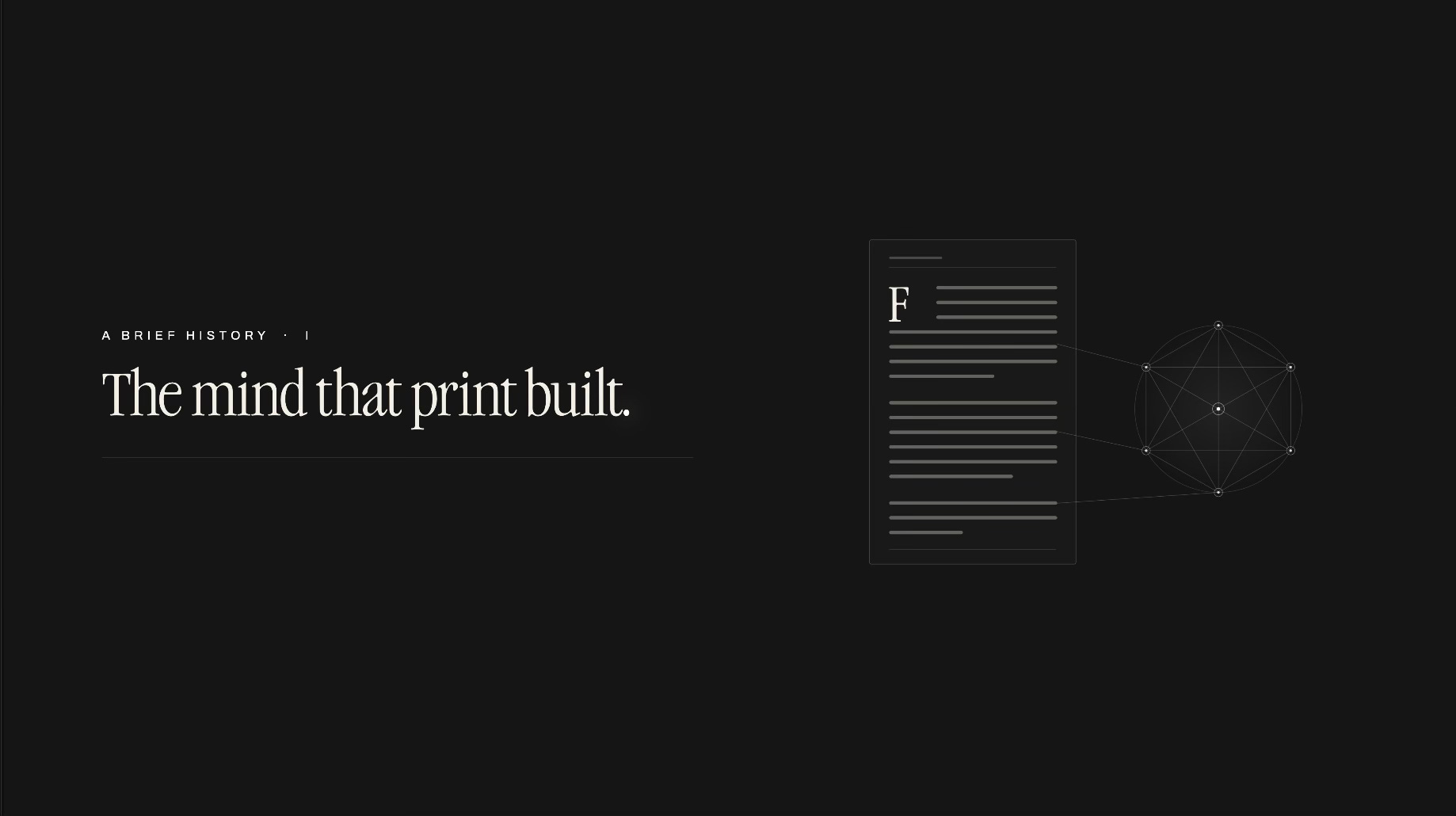
for hundreds of years, we communicated through print. the exposition era. black & white symbols on a page. this structured form inherently forced ideas to remain logical, orderly, and continuous. one idea naturally flows to the next. the current idea followed from the previous one. information was contextualized because it was designed to serve a specific person, in a specific situation, to create a specific understanding, and yield a specific meaningful action.
then we created the telegraph and the photograph. and with these came the distribution era. information became less about depth and more about novelty, surprise, and speed. the information wasn’t as useful as it was shocking and interesting—this made more money, so the presses followed.
Then came the entertainment era. the television transformed communication permanently. information evolved purely to stimulate the senses of the masses, not provide meaningful context and action for the individual.
That’s essentially the device in your pocket.
It’s designed to entertain you.
To make you consume, not think. to make you react, not live a life that matters.
You’re living in the wrong soil.
I’m not saying all social media is bad.
But social media is designed to serve one end: entertainment. Keeping you on the platform as long as possible to make as much money as possible from your attention, your most scarce resource.
The problem isn’t that social media is entertaining, it’s that all thought must be presented as entertainment in order to survive there.
Let me say it differently:
All social media is designed to entertain you, but is that actually getting you where you want to go?
Is that building the business of your dreams?
Is it creating the lifestyle you deeply want?
Is it forming a deep connection & impact with others?
Is it developing an inner world that you actually like?
Is your content actually something you would consume and use?
If you’re honest, the answer is probably no.
You know you’re made for more.
Instead, you just feel meaningless.
You feel meaningless because you have no order.
You have no order because you have no structure.
You have no structure because you do not write.
You do not write because you are perpetually stimulated.
A fragmented mind is inhospitable to deep work, let alone original thought & intrinsic enjoyment.
You’re overstimulated & burnt out because you’re living in the wrong soil.
Your mind isn’t designed to live in discontinuous, irrelevant 15 second fragments, on and off, throughout the entirety of your waking and sleeping life.
The human brain is designed for flow.
Flow requires structure — an intentionally designed ordering of consciousness.
We have no true ordering of consciousness because we let society & consumer culture (i.e. the magic brick in your pocket) form our minds for us.
Every decision is pre-programmed by someone else.
You probably don’t realize it because you’ve become so accustomed to it that it’s just normal now. the constant fragmentation feels like comfort because it fills a certain void you probably haven’t faced in years or decades.
I’m only saying this because it’s very true for me—I don’t just scroll because I’m bored. When I unconsciously check my phone, it’s usually because I don’t really want to exist in my own inner world as it is right now, although in that moment, I haven’t consciously recognized that problem. I’m just covering it, with more noise.
So we can’t access flow, creativity, enjoyment, or the mastery & meaning that result from it, because we’ve been unconsciously jammed into a vicious loop of rapid stimulation, motivation, and then collapse. then we chase more stimulation, get motivated again, get the next program, just to burn out two weeks later.
The vicious loop continues as long as you refuse to pause & actually think.
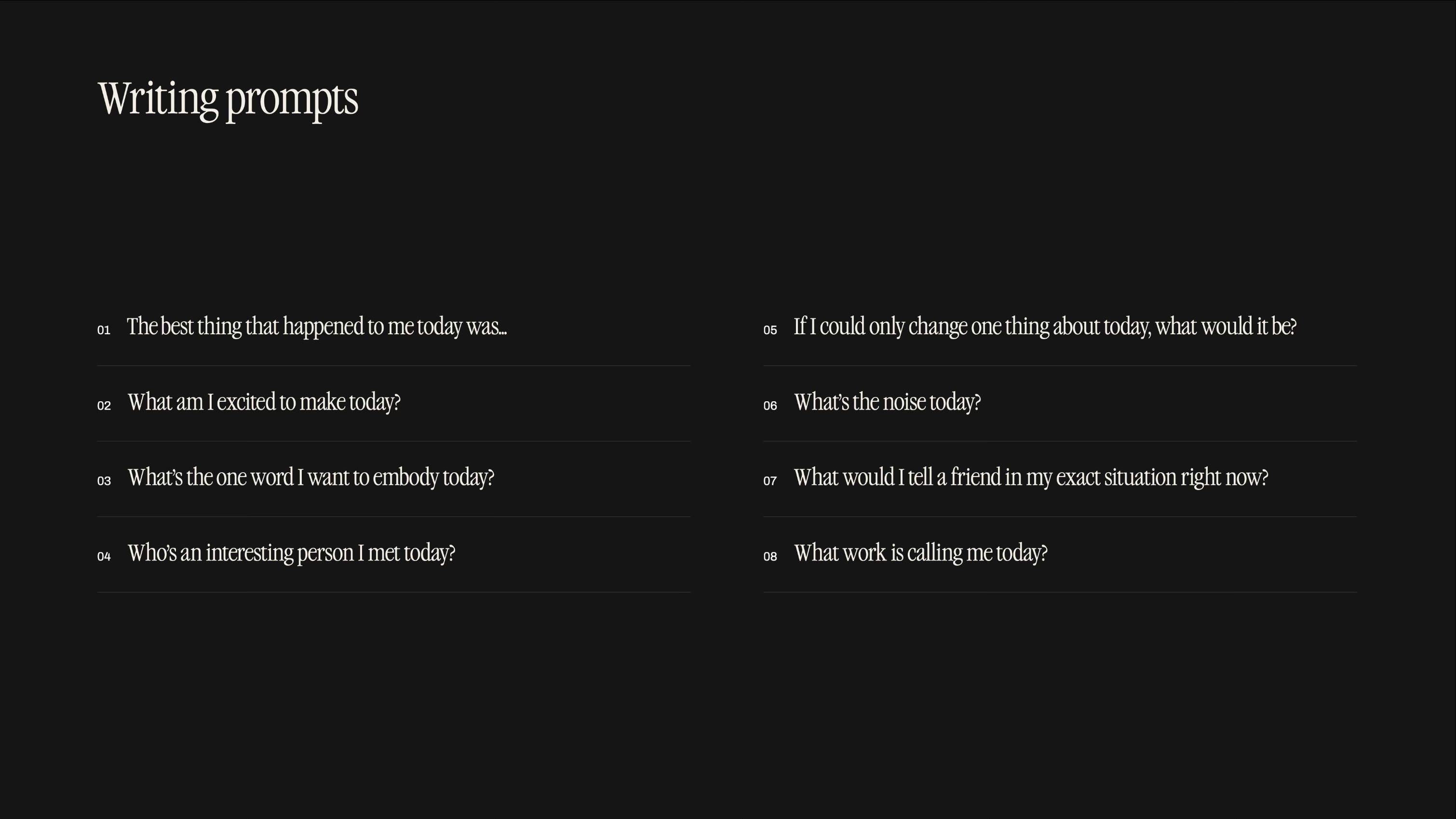
I could give you a whole batch of thinking prompts—and I have some at the end of this post—but you’ll be surprised what will happen for you if you just pause for 10-20 minutes every morning to just write. If that feels like too much, try 5 minutes. After 5-10 minutes, you’ll start getting into a flow. Flow always feels like friction first, but that’s just the necessary stimulus your brain needs to activate its pursuit mechanism, so you can follow an idea to its end, discover insights you didn’t know you had, and create your own experiment on yourself.
If social media is fast food, writing is the whole meal.
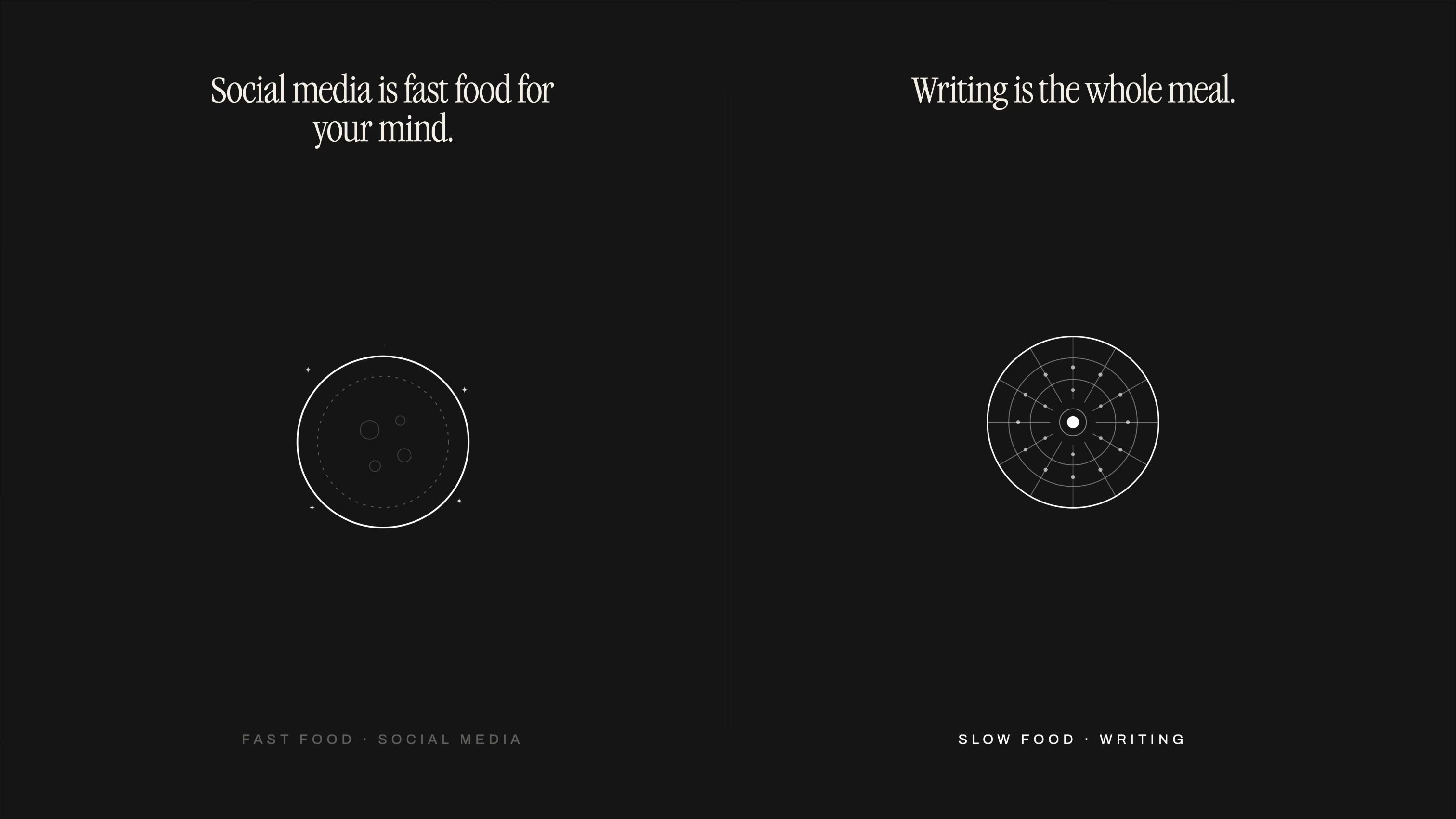
Everything in your phone, particularly social media, is hyper processed, ultra-condensed, relatively useless information that gets thrown at you at 1000mph. Everything screams for your attention. It seems like harmless fun, but it’s filling your head with senseless sensation, deprived of utility, meaning, and continuity—pulling you further and further into a black hole of emptiness.
Writing, on the other hand, is the slowest, most nutrient-dense form of information. It takes time to curate, consume, digest, and create—but it contains the necessary structure your mind needs to actually flourish. It’s the safe space for your ideas to cultivate and grow. It’s the deep soil that allows inner continuity and clarity.
So when you live in the shallows, you don’t just cost yourself clarity, you lose trust.
Fast impressions can create attraction, but they won’t develop trust.
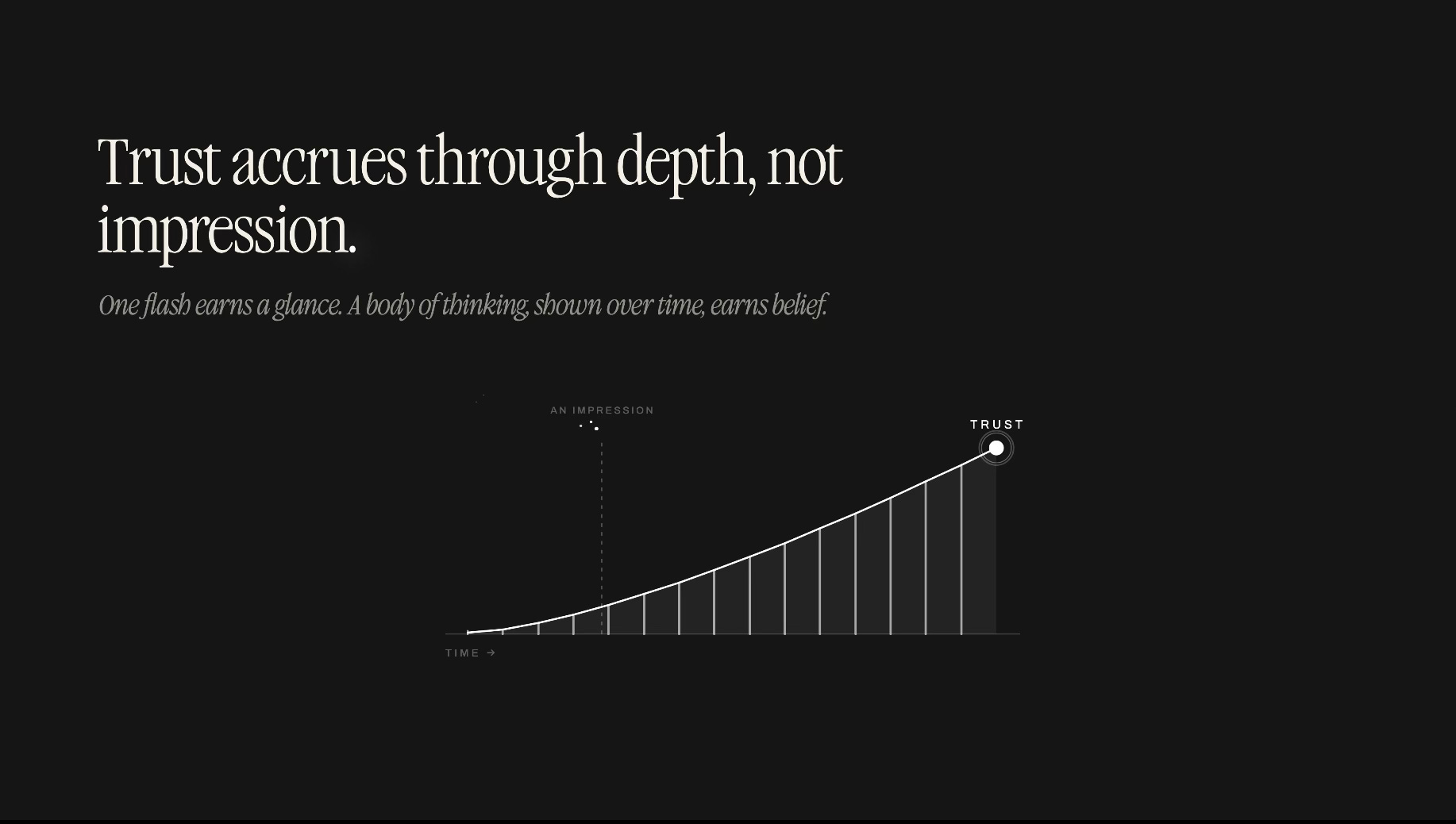
Trust accrues through demonstrated thinking over time.
Trust is at an all time low.
Only 34% of people believe others are actually trustworthy (according to a 2025 Pew Research study).
That means 66% of people don’t even trust their neighbor right now.
Most of your X, Instagram, & LinkedIn feeds are trashed with AI slop.
People are dying for real connection.
Trust has been declining for decades.
How do you create it?
(Be an actual person. lol). Seriously though, you can’t expect to be any different from everyone else out there if you can’t even articulate yourself clearly.
People follow people first. Then they follow brands under those people.
“You buy from humans you trust before you buy from logos you recognize.” — Matt Gray
We buy in through understanding. You can’t understand someone who can’t articulate themself. Writing is step one in becoming dangerously articulate.
If you can’t articulate your own thinking, why would someone trust you over someone else?
(Yes, results and outcomes obviously matter here. But when you’re comparing between option A and option B for the same product, who actually wins? The person you trust. The person you actually connect with).
Example:
In the AI space, people don’t buy AI services. They buy people who understand problems well enough to solve them with AI. They don’t trust the AI. They trust the person behind the AI that demonstrates a unique process, unique results, and a unique perspective behind all of it.
AI isn’t a solution.
It’s a tool to synthesize information and pass it from one form to the next.
It’s powerful in covering tons of ground in a matter of minutes, giving you broad domain knowledge, allowing you to spot gaps other players can’t see, create your own game, your own lane, your own unique position.
The problem with most generic AI advice is it often overlooks the unique context of the specific game you’re playing—the specific players, background, problems, and solutions at play. It risks replacing the actual work of thinking in your domain—where you can differentiate yourself, innovate, and win. Then you turn into another AI commodity.
There are places where your unique perspective, your hand, your taste, your signal still matter. I can’t say exactly what that is for you, but I know in my own craft this applies. (It’s your job to find what actually matters most to the people who pay you to do great work).
People buy your excellence, not your tools.
You should absolutely automate everything else that isn’t the exceptional, high leverage, high-trust work you do for people.
But having your own method, with your own results to show for it, will always beat the guy with the fancy AI gadgets and flashy cinematic effects who knows little to nothing about the problems he actually solves for specific people.
Your unique POV, results, and method gain infinitely more trust in the long game than the person just chasing the next AI trend and letting it do all the thinking for them. They seem smart on camera, but they become useless in the room when they’re thinking on their own.
Here’s the framework. Each element stands on its own, but they compound in order.
01 / Know your game
Before you optimize anything, figure out what game you’re actually playing. (This framework comes from Kallaway, one of the sharpest content strategists in the space, imo).
There are five content games, and each has different rules, different metrics, and different proof: (Choose wisely).
Game 1 / Entertainment media. Maximize views, monetize through CPM and brand deals. MrBeast, streamers, viral creators. The strategy is mass appeal and broad aperture. This game is arbing to zero, and AI will eat it first. Barrier to entry is high because you’re constantly competing in a race to more stimulating entertainment, at some point there’s diminishing returns. But if this is your sauce, go for it. Most people won’t be satisfied just aura farming or trolling on Instagram though, because they know they were made for more.
Game 2 / Education media. Still a views game, but the content teaches something viewers can actually apply. Same volume-dependence as game 1, just with tactical value attached. With AI replacing most information, I don’t know exactly what will happen to this industry.
Game 3 / Commoditized products. Clothing, furniture, physical goods. No education needed: people instantly understand the product. The play is visual storytelling and lifestyle association. How you create a unique lifestyle & aesthetic that others identify with.
Game 4 / Products that need education. Novel products like AG1. The audience doesn’t understand it yet, so the content’s job is closing that comprehension gap fast.
Game 5 / B2B services & trust businesses. Coaching, services, SaaS, info products. Requires real education and trust-building over time. The strategy: personal brand + narrow audience + consistent demonstrated value. Lowest view counts, highest profit per view. This is where the infinite game lives.
The barbell reality: the media game (1 & 2) is brutally hard to reach seven figures in. Only the top fraction of a percent make it.
The business game (5) is where content fuels offers you actually own.
The most common mistake is building a broad audience for the media game, then realizing you can’t monetize it with real offers.
Examples:
If you’re selling cinematic content services, your proof is “can you make my shit look dope,” not a follower count (i.e. the aura farmers).
If you’re selling your thinking, your proof is demonstrated depth over time to a narrow audience, not reach (i.e. Dan Koe).
If you’re selling coaching, your proof is transformation stories from people who started where your buyer is, not viral clips.
If you’re selling consulting, your proof is demonstrated thinking about your buyer’s exact problem, not general audience size.
If you’re selling a physical product, your proof is people wanting the life the product signals, not education about what it does.
Most creator misery comes from playing one game while measuring yourself by another game’s scoreboard. The business game doesn’t need millions of views. It needs the right 1,000 people watching closely.
The move: Write one sentence. “I’m playing [game], and the proof my buyer actually needs is [proof].”
02 / Reverse-engineer your reputation
Start at the end and work backwards. (This one comes from Caleb Ralston’s Brand Journey Framework.)
What’s the outcome you actually want? Name it specifically. Dream clients, paid speaking, a book, category leadership. Pick it.
What would you need to be known for to make that outcome inevitable?
What builds that association, and what dilutes it?
What gaps do you need to close to build that? What do you need to learn?
Brand is the intentional pairing of relevant things, done consistently. Nike paired itself with athletic greatness. You’re pairing yourself with something whether you know it or not. Choose it on purpose.
The move: Answer both questions on paper. Every piece of content you make either builds the association or dilutes it. This is why I don’t write my essays with AI. That would kill the association I’m trying to create.
03 / Automate everything except your distinct thinking
AI can cover the research, the packaging, the repurposing, the distribution. Let it.
What it can’t cover is the judgment underneath: the unique context of your specific game, your specific people, your specific problems. Generic AI output is the new baseline. The baseline is a commodity.
Automate: research, formatting, scheduling, repurposing, admin
Never automate: your point of view, your taste, your reps of actual thinking
The move: List everything you’re still doing manually that isn’t your unique 1%. Systemize or delegate it. Then guard the thinking time you just freed up like it’s your product, because it is. (This doesn’t always appear in the form of writing, it could be your editing work, your systems building, your software, your consulting, etc.). Point being, protect the deep work.
04 / Double down on the 1% only you can do
You are the niche. Your specific combination of skills, obsessions, story, and taste is the positioning. Stop trying to fit into someone else’s box.
The 1% breaks down into five things:
Signal / how you think. Your frameworks, your perspective, your depth.
Taste / how you deliver. What you let in shapes what you put out. Curate.
Operations / how you execute. Speed, volume, professionalism.
Personality / how you show up. The human people actually connect with.
Narrative / how people enter your world. The story only you can tell.
Practical tool for finding your angle: make two columns. Left side: everything your niche keeps repeating that you disagree with, where the nuance is missing, what feels cringe. Right side: write the opposite. That’s your positioning.
The move: Run the two-column exercise. You’ll sound different because you are different. You’ve just been rounding yourself off to fit in.
05 / Compounding via volume
Strategy is commoditized the moment it’s known. Execution through repetition is the actual moat. (Kallaway again: “volume negates everything.”)
Trust accrues in minutes. Every minute someone spends with your work is a trust block, and different asks require different block counts. An email signup takes a few. A high-ticket client takes hundreds. This is why bingeable, continuous bodies of work beat scattered one-offs.
The real KPI isn’t views. It’s iteration distance: how much you learn from one rep and apply to the next.
The move: Set a 20-minute timer and write. Signal is built there. Then publish, study the rep, and run it again. The framework isn’t a positioning exercise you do once. It’s a flywheel you run weekly.
I’m sure there’s more. There always is.
I’ll be doing a whole deep dive on how I’m building a profitable brand without millions of followers, specifically for creators who don’t just want views but want something they love that creates generational wealth. I haven’t done this yet, this is my moonshot, so it’s my number one project for the next decade and beyond. Self-experimentation is the fastest way to learn, so it’s both a series and a real sprint.
Why we write
The reason you write isn’t just to order your consciousness.
You write to articulate your point of view in a way only you can.
This will uniquely resonate with specific people. Your signal will naturally attract people you’d want to hang around and work with. (The point is building something with both passion and profit, right?)
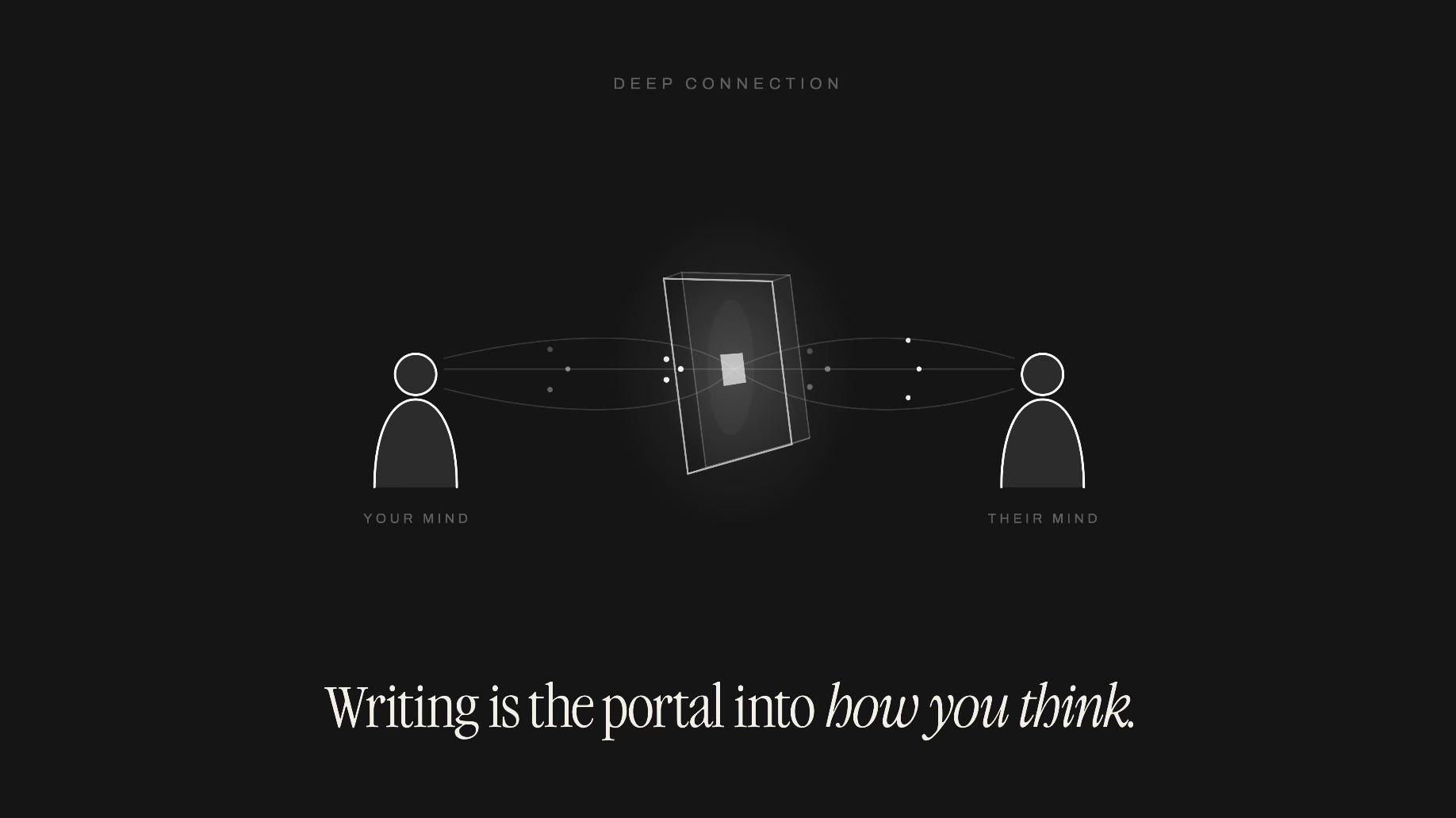
Writing is the portal into how you think. You create a unique conversation with each reader, allowing them to go deep into your world. “Highly binge-able content” as Kallaway mentions (marketing legend, imo) stems from highly continuous content. A coherent web of ideas that flow from one to the next, each interconnecting in delicate ways. Writing lets you assemble this in a way no one else can, allowing people to understand you, learn from you, and ultimately buy from you (as a result of trust accrual).
If you can’t even think clearly for yourself, why should anyone trust you to solve their next massive problem?
Everything originates in the realm of thought.
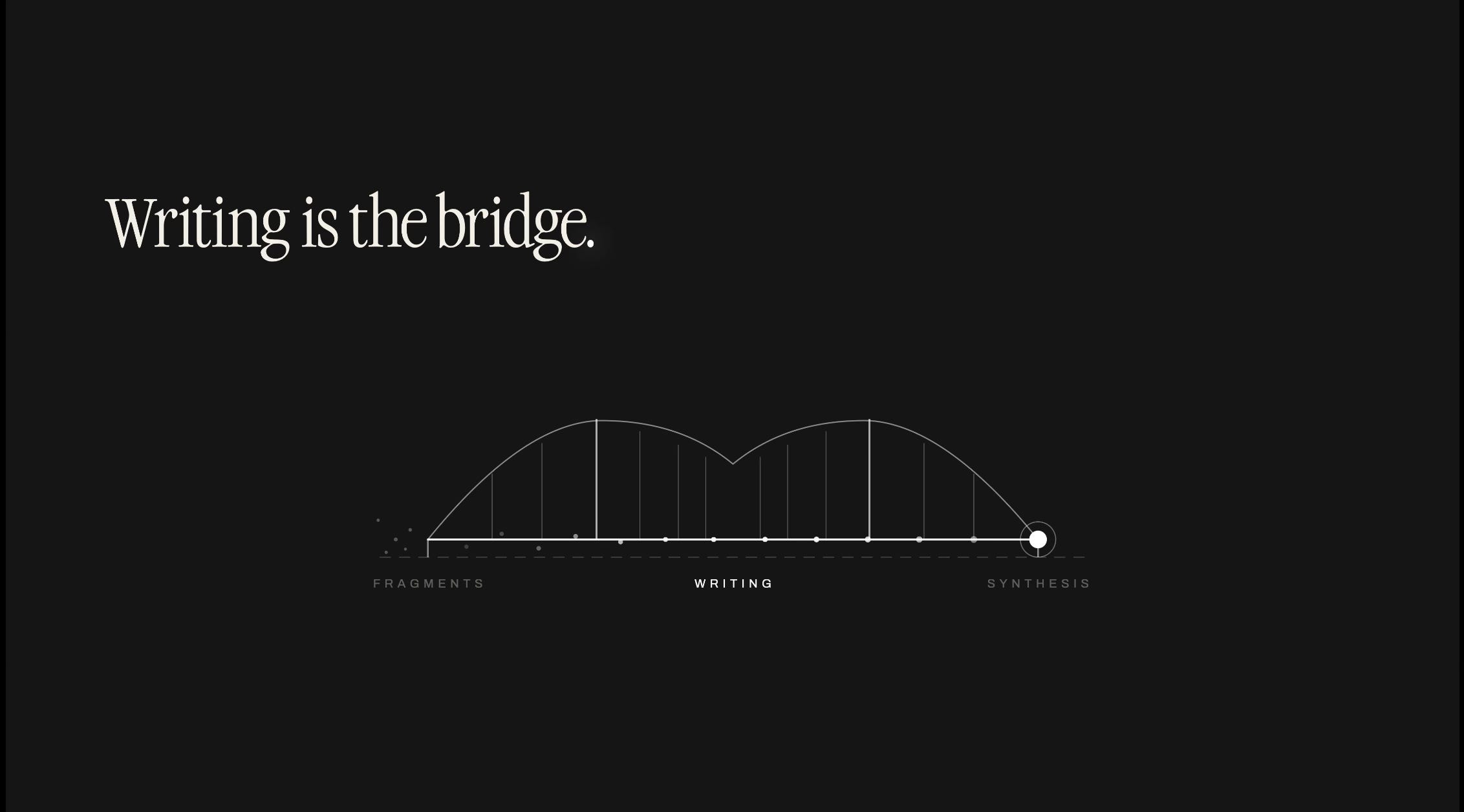
Writing is the bridge—bringing form to the formless, light to the unconscious. It allows thought to enter space and time, to transpire into something greater.
Writing is the seed of all creation.
Without language, we have no continuity of ideas, no structure, and no meaning—only perceptions and impressions that fade into the back of our minds to be forgotten until they come again.
Writing is how you architect your own mind, by design.
It’s what allows you to give form to consciousness.
In order for writing to make sense, it must be continuous. It’s a function of letters on the page.
WhisprFlow is obviously still incredibly useful for speed, but not every problem needs speed. Some things require a steady depth that only writing can provide.
With writing comes order, and with order comes flow.
And when you’re in flow, there really is no telling what you’ll find.
A simple practice
If you get only one thing from this post, please take this.
Before the calendars, the content, the meetings.
Set a 20 minute timer.
Write.
No structure or method.
Try the prompts if you need.
Try it for a week. Watch what unfolds.
I believe there’s a transformation buried in your keyboard, 20 minutes from now.
And it all begins with the simple choice to write.
—Dittmar
The writing prompts, as promised. This is just a shortlist.
References
This framework is a synthesis. Credit where it’s due:
Kallaway / The Five Content Games, the barbell reality of media vs. business, content minutes as trust blocks, “volume negates everything,” and iteration distance as the real KPI. From his content strategy masterclass material.
Caleb Ralston / The Brand Journey Framework (reverse-engineering from desired outcome to reputation), “brand is the intentional pairing of relevant things, done consistently,” and the two-column contrast exercise for positioning. From his personal branding course and workbook at calebralston.com
Dan Koe / “You are the niche,” the Meaning Economy, and the argument that as markets saturate and claims exhaust, brand becomes the final differentiator. From his letters at thedankoe.com
Matt Gray / People follow people first, then brands. Personal brand as the moat in a low-trust era. From his newsletter.
Pew Research Center / General Social Survey / The decline in social trust, from 46% of Americans saying “most people can be trusted” in 1972 to 34% today.