
You're not falling behind because of AI
Your thinking is your brand { + most people are giving it away }

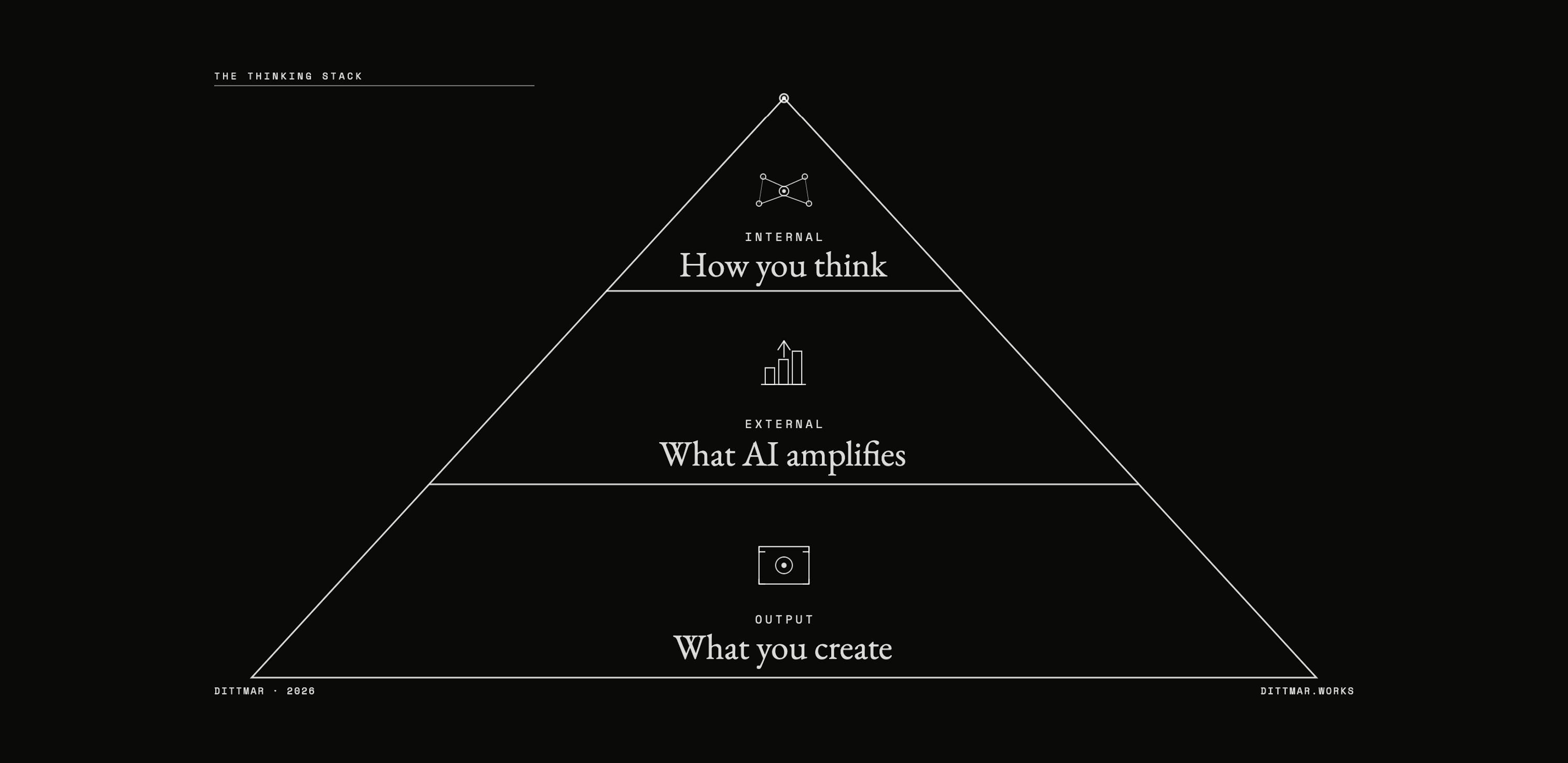
We are cooked, so it seems
AI is already smarter than you at 99% of what you already do every day.
But here’s what most people are doing.
They are grinding the same problems that they had last year, hoping this time they will be different. They get better tools, they buy better software, they invest in gear, they buy the courses.
But they fundamentally haven’t checked their trajectory & their compass in years.
{ Grab the accompanying free compass prompt here so you can implement these ideas, not just philosophize lol }
It’s fair to say we’re all a little concerned at this point.
We really don’t know how to cope with the scope of change that is coming - as creators, knowledge workers { whoever you are } - and that’s not because we’re lazy.
It’s because the landscape is changing faster than our frameworks can handle.
You’re probably still at your desk, grinding away, going nowhere.
You’re building agents. You’re automating tasks. You’ve created more workflows and Claude Notion agent systems than 99% of people in 2026, yet you still have no leverage because you haven’t actually defined & comprehended what leverage actually is in this era of creation.
Whether or not you’re a creator, everyone’s concerned for their survival.
No matter what your role is, the landscape is changing fast.
And nobody really has “the answer.”
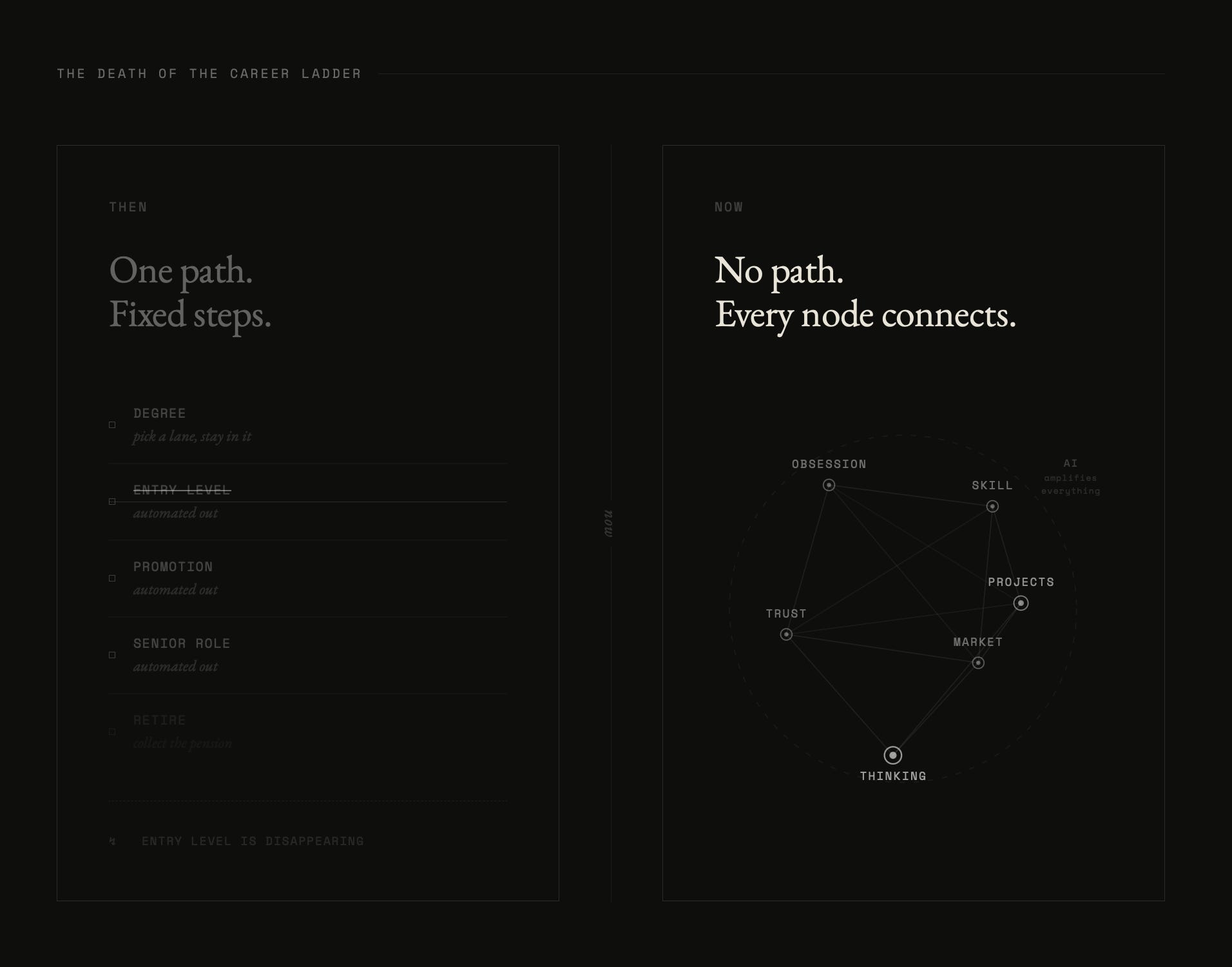
This is particularly challenging for us young creators/workers 18-25 because we don’t have the same career ladder that everyone else did before us.
My aspirations have changed every year since I was five. First I thought I’d be a race car driver. Somewhere along the way I learned that wasn’t possible, and took on a list of other future identities to perform my way through school & life. “Architect,” “Navy SEAL,” “Pilot,” “Neuroscientist,” “Engineer,” “Car Designer,” “Photographer,” “Model” - & the list goes on.
Two weeks into my Navy scholarship, on my dream path to becoming a Navy SEAL, I got medically disqualified. My entire world collapsed, except for my north star: do something hard & complex, with a lot of passion, making a lot of money, & making the greatest impact possible.
I tried fitness coaching, marketing, content, patent design, product design, systems & AI, Notion second brains, & serving at a luxury restaurant.
One shift at the restaurant my friend Leo casually told me about his $15k week washing windows. In 10 seconds my entire money model collapsed.
All he did was create enough trust that money naturally flowed to him as a byproduct of his service & delivery. It wasn’t just his product - it was how he was known. Somehow he was getting rich people to pay him $500 an hour doing something as simple as cleaning windows.
Windows.
“What the hell? How am I grinding 50 hours a week making less than $3k a month and he’s making $15k in a single week?”
That’s roughly how I remember it in my head.
The idea of doing your own thing used to seem suspicious and uncertain. But now in the uncertainty of “normal” work, it may be your only certain vessel.
The game is to build it.
To know the territory and build it right.
Your projects are the career ladder now. The quality of your projects is the quality of your prospects.
The last advantage
In the AI era, your only real advantage is the quality of your thinking - and most people are destroying theirs by staying in execution mode 24/7.
Most people are too busy in the operational grind to even notice the framework running that mind and how outdated it really is, how one-dimensional it really is, how tribal it really is, and just how low-leverage it actually is.
When you really zoom out, you see how much leverage you’re leaving on the table, how many resources you’re not tapping into - - simply because you’ve allowed all of your bandwidth to be consumed by living in the operations of survival mode.
I get it, you have to survive.
But if you don’t create space to think, you won’t be able to build yourself out of the trap that your current level of thinking & operating got you into.
And with the speed of change increasing exponentially every day - - if you don’t make these adjustments quickly, and make the margin to actually learn, think, and build leverage with AI - - you just lose time, you lose ground, and you become a slave to your own machine.
The automation trap
The stupid trap I see on the internet is people rushing to automate things that didn’t even matter in the first place.
Getting agents to do things that don’t even matter for your outcomes isn’t productivity - it’s low quality thinking that creates low quality outcomes.
Obviously if you’re just creating for the short term game with short term people, please disregard everything I’m saying. There’s plenty of short term gains to be made with AI, and if that’s your thing, do your thing.
Cal Newport talks about the dangers of visible productivity.
When tech gets faster, we become hyperconnected, and what’s valuable seems to be speed: How much you can get done, how fast you can distribute it to teams, peers, social media, etc.
But what gets missed in the rush is the thinking that determines what’s actually worth pursuing in the first place.
That sounds trivial - “just think more”
But without it, you are running a random race with a landscape, rules, players, & outcomes that you didn’t choose - and that’s a recipe for becoming miserable & replacable.
I’m not saying you shouldn’t automate - you absolutely should.
But if you don’t know what game you’re in, what leverage really is for your context, what value is for your game, you’re flying blind. { I made a positioning framework & prompt for this, you can grab them at the end if you like }
Faster execution doesn’t guarantee shit if you’re learning the wrong lessons and playing the wrong games.
And there’s a massive opportunity in the shallow race.
The contrast between deep & shallow work - between clear thinkers & the small minded - is increasing rapidly.
The value of quality is about to skyrocket.
Quality requires patience, taste, discernment, depth, focus, & clarity.
Quality creates trust. Keep that in mind moving forward.
The genius margins { white space }
Before I give you tactics, we need to think again.
I want you to suspend your ideas about how progress works and approach it with a fresh mind right now.
This is the only valid tactic I can give you atm because every game has increased in complexity & uncertainty.
I could give you a roadmap, but you can ask chat for that, or watch Dan Koe’s, or Caleb Ralston’s, or Alex Hormozi’s videos.
The tactics are obvious.
The thinking is nebulous.
The game is to simplify it to the point where high leverage action is inevitable & obvious.
Strategy is really easy if you know how to think for yourself. But nobody teaches you that in school. So you’re left to experiment on your own or blindly let AI think for you - both are not optimal.
I don’t have the formula, but I’ve derived moments of clarity & leverage into the simplest framework possible, and that’s what I’m giving you here - in hopes that you’ll be able to create your own problem-solving tools with this meta skill.
You still need skills, but they’re cooked without clarity.
Clarity is the sauce.
And here’s the basic element you’re missing.
Margins.
I call it white space.
Genius thinking happens in the margins - both literally, temporally, and conceptually { more on that another time }
But your world has engineered space { i.e. boredom } out of your life completely.
Pay attention to this.
The more white space { margin } you create in your life,
the better you think,
the better your decisions,
the better your life quality & outcomes.
That’s the meta sauce.
Take that with you everywhere - it’s the #1 thing we’re most prone to forget. And once we forget, we’re back into the void & there’s no telling when we’ll come back.
Your subconscious wants to work for you
but it can’t create for you unless you feed it with quality signal & give it space to digest that information to create new insights & realities.
It’s a virtuous loop
Noah Zender writes about this idea here.
I wrote a deep dive on white space here as well.
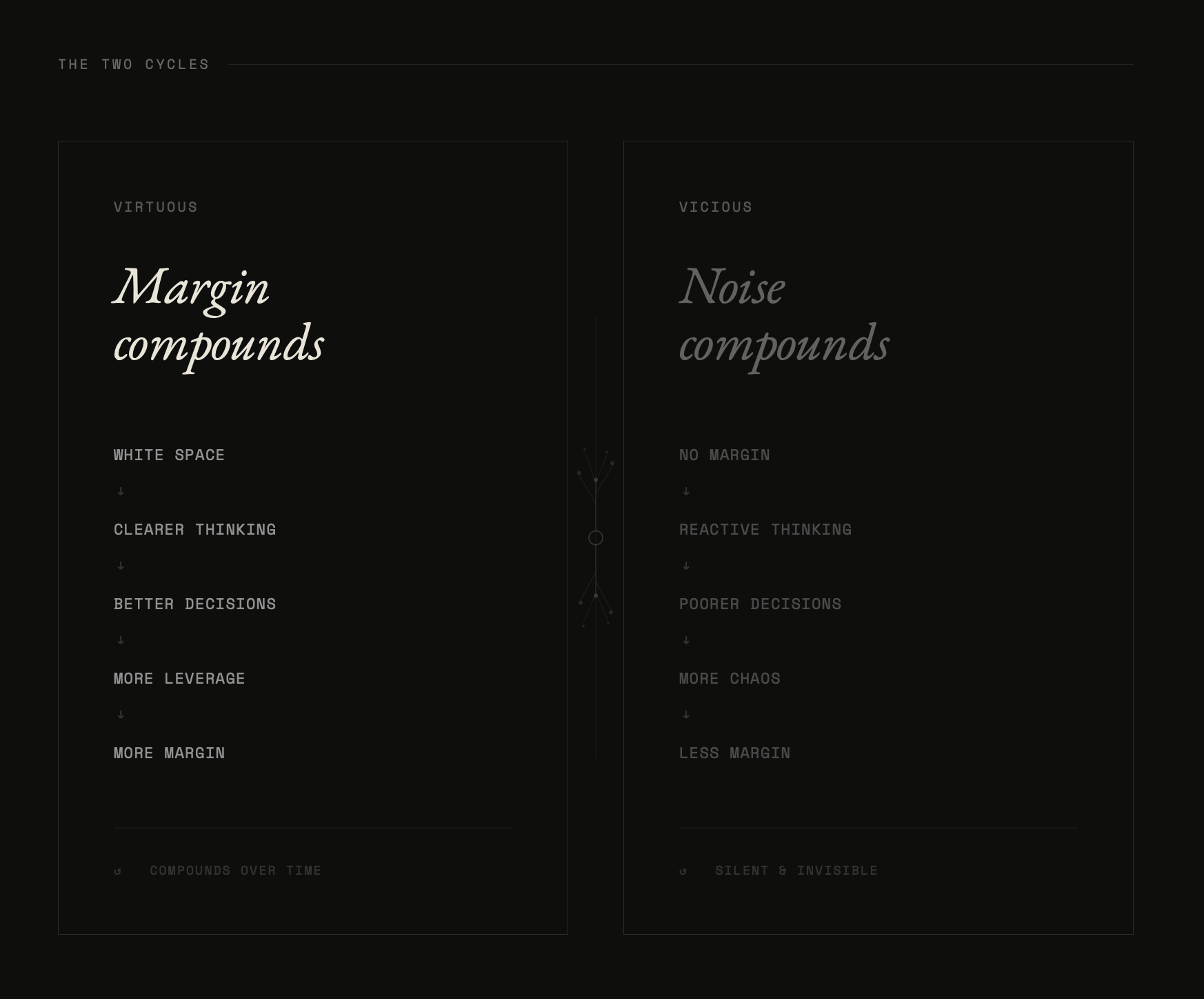
Now let’s try the other side - things get chaotic quickly.
Less margin { white space } → less thinking / shallower thinking → poorer decisions → more chaos → less margin
{ And so the vicious cycle continues | you end up miserable }
Here’s some comfort for you.
{ It’s your fault, and that’s good }
All of this is held in one small decision, in this very moment:
the assumptions you hold in your mind { displayed through your day-to-day reactions & questions in your life }
the ideas you program into your subconscious { i.e. what you consume & how you talk to yourself }
the spaces & moments you create in your day { or not }
the energy you create in your body
the texture of your awareness { focused / expansive, deep / shallow, etc. }
the quality of your questions
The time we create, the habits we design, the moments we make, the goals we select, the environments we build { not just physically } - all determine the margins in your life, or lack thereof.
You either protect & direct your focus, or neglect & reject your focus.
If you neglect focus, you reject autonomy & agency in your life. You resign from creating a meaningful life - your world is so oversaturated with the noise of other’s demands & goals assigned to you that your life loses all color.
But the moment you choose your focus consciously, that one small moment is the inflection point of your entire life - a wave of momentum awaits.
The moment you create a space of focus - to think, learn, & create - you start to gain leverage back, you start to feel fulfilled, your world feels colorful again { and you solve problems much faster }
It’s one decision. right now.
If you gain nothing else from this:
Remember:
Greatness is built one small decision at a time. One bet on your future. One bet on possibility. One investment in your consciousness. Your mind expands the moment you let it.
You must be aggressive about protecting spaces of free thought, learning, creating, & reflecting - but be very gentle in the space of creation. Ideas are delicate things. Forcing the idea rarely works.
You’re entirely in control of the spaces you make in your day: Whether you play music in the car or just think, whether you scroll on your phone or go for a walk, whether you take 2 minutes to breathe or rush into your default reaction to a perceived threat.
All of that & more - is a choice.
Conscious or not, you can create a breath of awareness, a fresh pocket of clarity to see things from outside your typical unconscious operating system.
You don’t have to think about things the same way every time.
Clear thinking doesn’t happen in the rush.
You won’t become a better thinker by reacting to every impulse and emergency that hits the radar of your attention.
Your mind is not a pinball machine.
It’s an F1 car.
But the longer you treat it like a slot machine, the more garbage you feed it - the less you protect your time & attention - the more robotic, replaceable, & miserable you become.
When your attention is chaotic, your life is chaotic.
When you fail to order consciousness, your world loses meaning.
Let’s not do that.
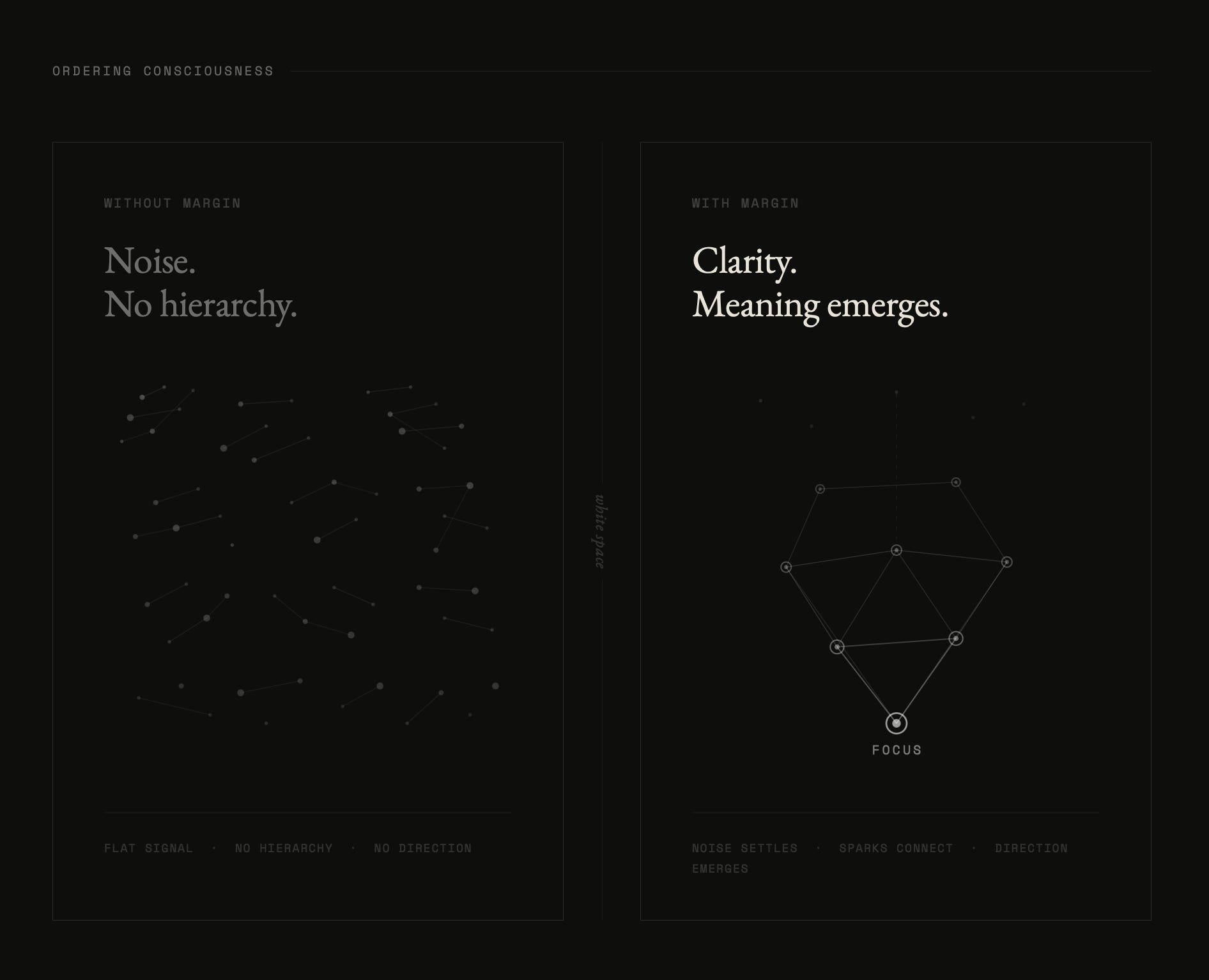
Thinking clearly is an art.
Erring effectively is a science.
Treat them as such.
Practice, practice, practice.
They’re vital to your survival as a creator or knowledge worker.
The ritual { DaVinci | Ogilvy | Jiro }
Before we get more tactical - { we will, I promise } - I have a simple ritual to share with you.
What’s the single thing DaVinci would never let Jarvis touch?
One thing I noticed about all the greats is their obsessive protection of their space.
David Ogilvy went for long walks, so does Jiro, so did DaVinci and countless others.
The hack in 2026 has less to do with maximizing your hours and more to do with minimizing the low signal, low leverage nonsense that you keep letting eat into your day, your mental space, and ultimately your creative output.
I’m going to give you one tool that I believe will the easiest and most powerful install if you take it seriously.
Power off your phone.
Let people know you’ll be unreachable for a while - depending on how much clarity you want.
Grab a notebook & pen.
Take a watch if you need to keep track of time { though you could just plan out a route that takes x minutes, i.e. 2 mile loop, ~45 mins if you’re taking your time }
And just walk.
Breathe.
Let your mind notice things.
The first 10 minutes might feel like torture if you haven’t been away from the stimuli in a while.
But this is exactly what DaVinci, Carl Jung, & David Ogilvy would do.
Countless other greats have similar tendencies of disappearing for days or months on end.
You don’t need to disappear for a month.
10 minutes is enough space to reset your mind deeply.
45 minutes is blissful.
Give it three days - no phone, just pen, paper, watch - and your clarity will transform.
It’s really not magic, and you’ve probably been told to do this before.
But the chances of you actually sticking to a system long enough to get its benefits depends on its simplicity.
I love this routine because it’s too simple to mess up.
Just walk, and notice.
You don’t have to do anything.
The pen is there if something comes. If not, no worries.
Your mind is clearing, that’s enough.
We’ve convinced ourselves that productivity means being maximally engaged & stimulated at all hours of the day when in reality most of your problems could be solved if you just gave your subconscious mind the space to actually work on them.
The subconscious mind works 220,000 times faster than the conscious mind.
That undirected attention is powerful - - but only if you give it the space to work.
It doesn’t work when you’re bombarded 24/7 with hyper engaging stimuli - I’m not just talking about social media, I mean mobile phones as a whole.
You will be surprised how much clarity you can create with pen, paper, and time.
You don’t need Claude. You don’t need someone to teach you this. You just need the space to learn it for yourself.
If you want clarity, disappear for 3 days. Hopefully I’ve made that clear.
If you’re not convinced, I’m moving on to more tactical tools now.
At a minimum, create 10-45 minutes of white space in your day.
It’s as simple as not filling every moment with a phone check or a response - you probably don’t have to, but your brain thinks that because that’s how you’ve trained it thus far.
Ogilvy would just collect the raw materials, digest them, and wait for his subconscious to come up with something great. That last step - leaving space for the subconscious to synthesize - is the #1 thing 99% of creators lack. And it’s not for lack of time. It’s lack of awareness to how you’re spending it. Step back. Zoom out. You have time. Giving your brain space to think will pay dividends in the next 10 years, even if you don’t know where you’re going yet.
With clarity out of the way - { barely } - let’s talk about being effective & high leverage.
The infinite era of information & execution
Information is a commodity. Personality is irreplaceable.
— Caleb Ralston
Being an actual person on the internet is rare as fuck, because most people are just doing everything with AI and leaving nothing to taste. { This will work wonders in the short term with lower quality, shorter term people but it builds zero trust in the long game }
For example: [ sei ] is a dope Instagram account. All AI written, all AI voices. I’m sure there’s human ideation involved, the stuff is interesting, but I don’t connect to it like Caleb Ralston or Dan Koe because it’s just an AI talking. It’s shit I could learn anywhere. There’s no real sauce, no differentiated opinion.
Nobody cares about the information you have.
Everyone has the same information & tools, more or less.
Very few people have the experience, the discernment, and the articulation to actually turn that into real value.
By the way, if you’re not following Caleb Ralston, what are you doing.. he’s the guy behind Alex Hormozi’s successful brand, he’s cracked. He’ll teach you more about brand & leverage than I ever could.
The Convergence of Games
People who just live on claude and never actually develop the high leverage distribution via their own thinking are giving up the greatest asset they have. Trust. Trust is the greatest economic factor on the planet. And it’s built by distributing your own thinking, your own personality, your own stories with actual people.
When two people are selling the exact same thing with the same features - { or same content online, same ideas, same skills } - the only thing that actually differentiates them is the trust they’ve created with a person.
It’s their personality, it’s their humanity, it’s their own unique opinion.
That means they have to understand how they actually think.
If they outsource their own thinking, they don’t actually understand how they think and they become a summary of the internet, another generic brand, just like everyone else on the internet.
Fine short term, cooked long term.
The way that you become an untouchable brand is by understanding what can’t be touched in your brand - { i.e. the thinking behind it }
People come to me for cinematography not because I’m objectively better than the other options but because they know, like & trust me more than my competitors. They know how I deliver, they know my taste, and they trust that more than the guy on Fiverr charging less or more.
What’s also insane is that someone with worse skills than you can make more money simply because their clients actually trust them. Their clients actually know them.
They showed up before you, in person, they made the connection, they got the sale, they got the trust.
The difference in that scenario is literally just showing up.
Bring your own agents { + frameworks }
Whether you’re a knowledge worker, data scientist, entrepreneur, creator, marketer - it doesn’t matter - the game is collapsing into “bring your own software.”
Your own proprietary workflows & frameworks.
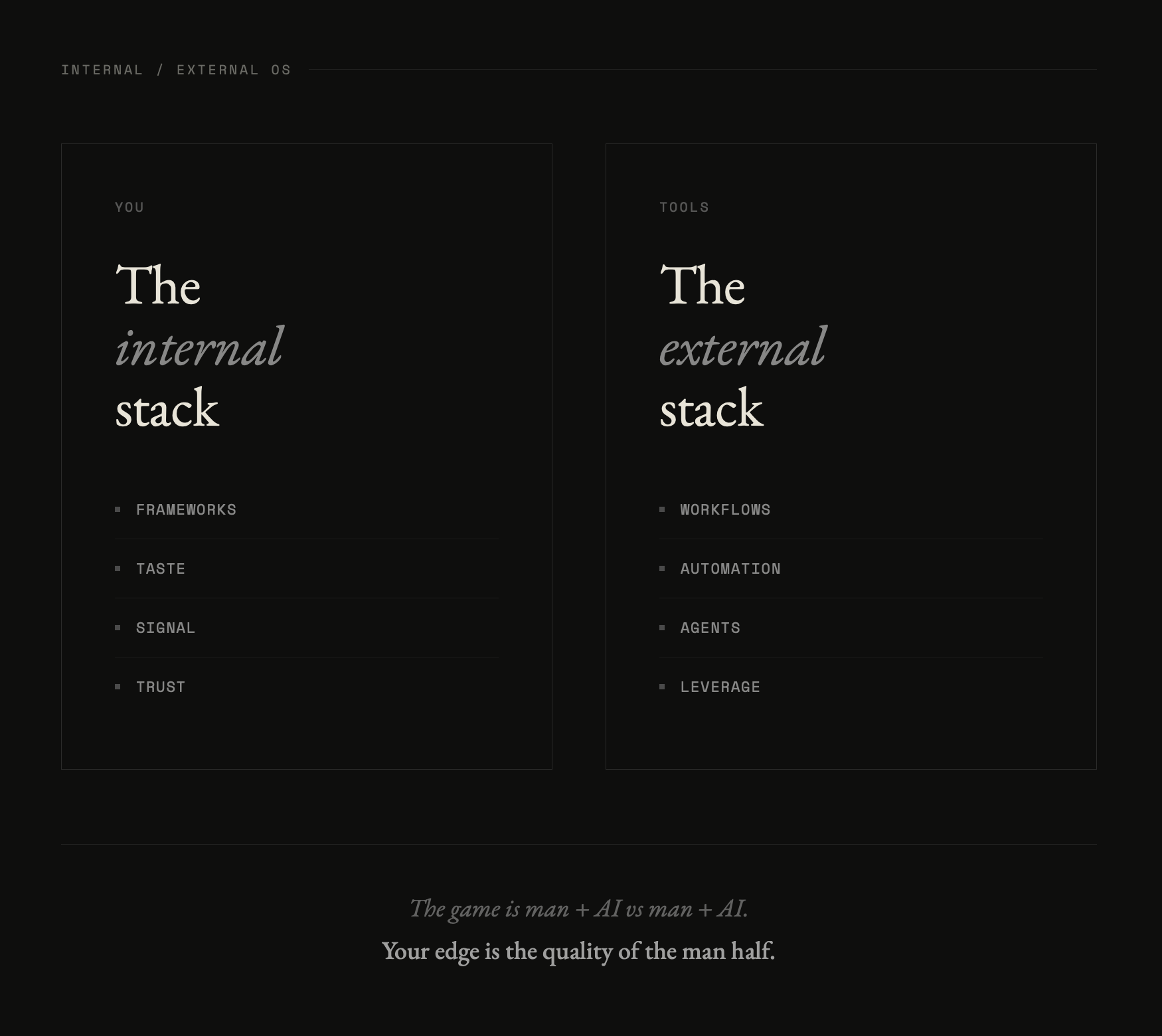
It’s “you” + “tool stack” vs “someone else” + “tool stack.”
Obviously, learning how to use AI in everything you do is going to have outsized returns on literally everything you do.
In this sense, it’s your #1-#10 priority, { thanks Alex Hormuz - watch his recent video to learn more about this } - i.e. if you don’t want to get replaced or fired, you must become AI-first & automate yourself out of shallow work before someone else does.
But there’s another { arguably more important } angle to consider as well.
In becoming AI-first, there still lies the danger of losing your ability to think effectively. And I think I’ve made it pretty clear why that’s critical.
Most tools are already converging on the same point of optimization, so tool advantages will be relatively flat in the long term.
Most apps will work the same, cracked out, agentic AI workflows with synchronized context mapping across several projects & goals at any given time. F*ing dope.
But…
What makes you buy from one software or another is less about features and more about taste & trust.
You buy from one because you know, like, & trust them more.
The tool advantage is still real - there are fourteen year olds making $30k deals on clawmart selling prompts, skills & app installs. That’s cracked { like actually - what the hell - how am I still broke }
But in the long game - assuming you and your competitors have roughly the same tools - the differentiator will break down into this.
Obviously lock in your leverage, systems, & agents. Be AI-first. Automate yourself out of shallow / low-leverage work before someone else does.
But if you don’t learn how to think, your tools won’t matter much in the long term anyway.
If you don't take the time to think, it’s very unlikely you’ll even see the dangers, opportunities & higher leverage plays already in your hands - { I have a simple example from yesterday - it’s profound - keep reading - you will use it }
The internal operating system behind the external workflows & agents determines how you position yourself as a brand, how you distribute your work, and how you package it for others to consume & ultimately buy.
Quality of thinking { the internal os} determines quality of agents - it’s how you create a unique taste online and build trust with an audience. They know your voice, your thoughts, your style.
Once everyone’s optimized, the only differentiator will be the internal processes no one can steal without putting a chip in your brain - your thinking, your frameworks, your taste, your stories, your ability to self-direct & to solve problems.
As long as most people have access to roughly the same tools, the game will still be man vs man.
And even then, your unique story & taste will naturally make you more preferable to some and less to others, in the same domain.
Even the idea of competition is an illusion that keeps you from creating.
You see other people doing it
You interpret that as “the space is saturated,”
Then you do nothing - - *assuming* that because others are already doing it successfully, you can’t.
Winners focus on winning. Losers focus on winners.
— Alex Hormozi
Change the assumption:
“Others are doing it successfully.” → { You can do it too } → & there’s a space for you in the same domain as someone else because people prefer different personalities, perspectives, & tastes.
Again, this is why you must learn how you originally think.
Don’t outsource this - this is your sauce.
That’s how people know your voice from someone else’s.
Stay distinct, don’t dilute your signal.
Be precise, not general.
Be concrete, not vague.
{ Funny how writing tools from William Zinsser transfer perfectly to sales, persuasion, & effective thinking }
Keep building your own web of ideas.
And then follow this method below -
The positioning framework
Here’s the method I learned recently from a serial entrepreneur that transformed my work - like yesterday.
We were talking about my cinematography business & my plan to convert more leads.
I talked about my passion, filming cars.
I explained my strategy to sell to luxury apartments & gyms because their socials suck.
And then he slapped me in the face with this question:
Who has the money & is willing to pay for your service right now?
What problem does your work actually solve & offer to them?
But we didn’t go the luxury gym route, he looked what I was already obsessing over every day - cars.
He took my most natural obsession, & my most gifted skill, and opened the element I completely missed: positioning & persuasion.
You can have the greatest ideas, be the most passionate person in the room, and work harder than everyone else - but if you don’t know how to position yourself in front of the right people, none of that work matters. No one will see your work, and no one will care.
The game isn’t just passion & proficiency - it’s positioning, persuasion, & profit.
This isn’t just “sell to the rich” - although that is genuinely the easiest & simplest way to make money doing something you’re good at.
It’s learning where to place your attention & your work, so that you can get the feedback necessary to expand and grow, and create the life of your dreams.
I’ve never felt more free.
Not because he showed me something I didn’t know.
He simply revealed and reminded me of what I already knew, and what I already had.
“What resources & opportunities do I have that I’m not currently taking advantage of?”
That’s a question from Bill Walsh’s book “The Score Takes Care of Itself” { read it } - and it neatly summarized this.
It’s the element most of us miss - because we’re too busy to notice it.
You must position yourself to win.
Positioning requires clear thinking.
Be the craftsman, create white space, follow your interests - yes of course.
But miss the positioning, the persuasion - and it all dies.
When you unlock clear positioning - & how to package your work as an offer to someone else - you unlock true profit & life freedom.
You’re able to truly live your life’s work.
The lines between work & play blur entirely because all you’re doing every day is following your natural ability & sharpening it, while serving the people who want it - and thus receiving the natural exchange of that trust created - the money - which thus sustains the making.
That’s how I understand problem solving now - and it’s very, very useful.
Thinking must create new execution. You’re not creating productive thinking & problem solving if your behavior doesn’t change.
Writing is the act of shifting your understanding, your model of reality, your conscious & unconscious biases, and the behavior that flows as a result.
All this entrepreneur did was guide me through a better thinking process about the things I already loved, the things I was already good at, the opportunities that were already there, and the people that were already there for me to serve.
And it was *obvious* what to do next.
A powerful thinking process makes it so obvious what the next right action is that action has no choice but to follow.
Answer these four questions, and you’ll be moving in an exciting direction.
What do you naturally obsess over?
What are you already good at?
Who has the money and wants that right now?
How do you position yourself in front of them?
When you truly understand the problem, it disappears
—Naval
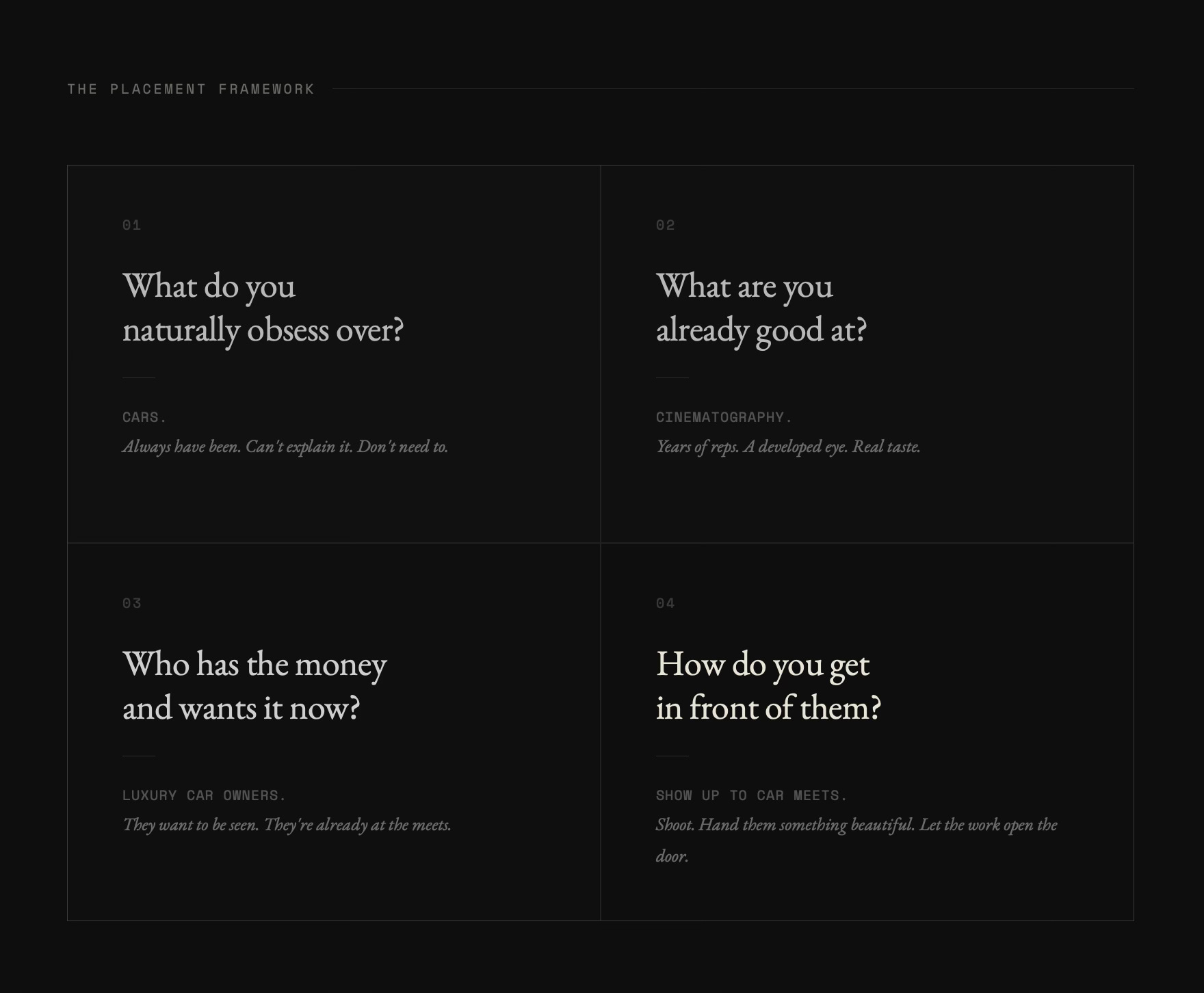
I made a prompt to walk you through this here. It’s free.
100x is not the solution
Most people just tell you to do 100x volume and it’ll solve all your problems.
But if that 100x volume sounds like a chore, you’re doing the wrong thing.
100x won’t matter if it’s a replaceable commodity.
If you’re not thinking clearly about what is that you’re doing day to day, why, and how that’s something AI won’t replace in the next three years, what are you so busy doing?
Thinking the tipping point that determines everything about where you go next.
It determines the leverage you create with every choice you make every day - or not.
Your thinking is either compounding into a work & life that you love, or it’s slowly killing you every day.
Thinking is an investment, not just a random act.
When you give it margin, you increase it’s quality, and your long term investments grow { i.e. better decisions compound every day - math }
When you create those margins - notice what sparks curiosity. There’s an infinite reservoir of dopamine for curiosity, but it begins with giving your brain the time and space to notice in the first place.
I’m writing this because I’m highly curious about the mind, flow, brand { i.e. trust & culture & communication & storytelling & connection } how we as humans elevate and shift through deep practice, etc. etc. { I could go on }
I couldn’t write 4,000 words on something straight unless my mind was absolutely obsessed with it.
I’m playing an infinite game & I can’t stop talking about it.
I couldn’t have found something I’m obsessed with unless I created the space for it to rise in the first place.
Great ideas arise from the unconscious, but your unconscious needs margins to breathe.
Give your mind the white space.
Watch what shifts within.
— Dittmar
PS - If you want to know about the thinking os I’m working on - something that streamlines your brain and handles the busywork so you can just drop into flow - comment your email and I’ll send you the beta when it’s ready xx.
If you haven’t grabbed the meta prompt for positioning, get it here. { free }